
Inclusion
The Environmental Studies Department at Gettysburg College is committed to providing a welcoming, safe, and inclusive environment where everyone can thrive. The department seeks to build and support a community of students and faculty from diverse backgrounds with respect to race, ethnicity, socio-economic status, religion, gender, gender identity, sexual orientation, disability, and nationality.
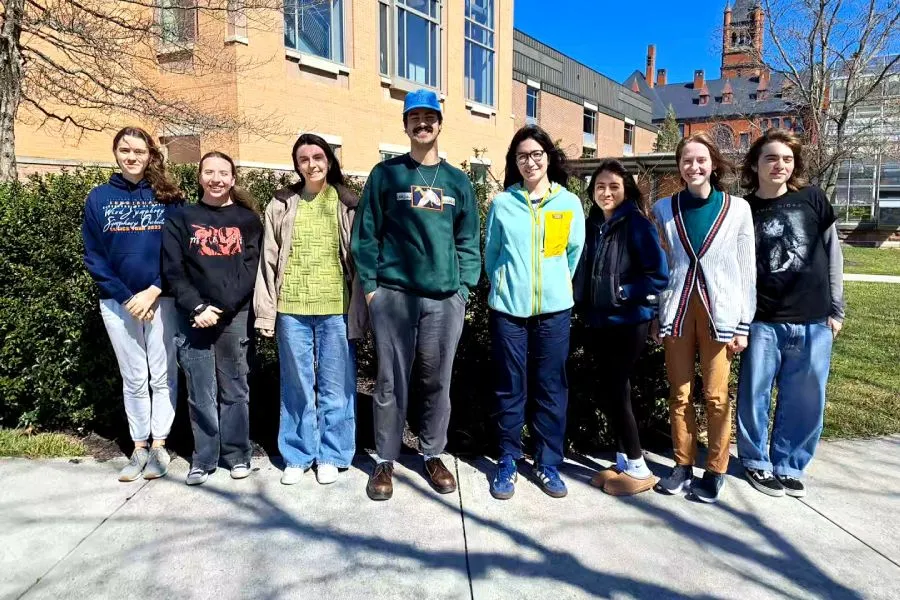
ES students are actively working to enhance diversity, equity, inclusion, belonging, and justice within the department. Specifically, the Student Advisory Board is a collection of motivated students (pictured below) from a variety of concentrations and class years who work on many important projects in collaboration with ES faculty. These projects focus on creating a sense of community and a fair learning environment within the department through enhancing curricular and co-curricular offerings. Some examples include planning relevant and fun events, fostering effective communication and outreach through a monthly newsletter and Instagram account (check out @gburgesdep), and raising DEIBJ awareness for both students and faculty. Please don't hesitate to reach out!
The Environmental Studies Department at Gettysburg College is committed to anti-racism and dismantling structures of discrimination through our courses and our everyday working environments.
We recognize that racism along with other forms of discrimination—such as sexism, classism, and (dis)ableism—structure and plague our current institutional systems. These structures normalize inequitable distribution of rights, opportunities, and experiences.
In our interdisciplinary courses, through attention to environmental justice issues, we help students understand how institutional social systems as well as systems of interpersonal behaviors and attitudes can be discriminatory and unjust, and invite them to participate in re-orienting these systems towards equality and justice.
In our social science and humanities courses:
- Students engage with primary and secondary sources that expose historical and contemporary experiences of power, privilege and oppression within environmental movements and public policy making.
- Students are encouraged to reflect actively on the micro and macro factors that exclude and make invisible voices from racialized, ethnic, gender and sexuality-based (e.g. LGBTQ+), and other disenfranchised demographics.
- Students interrogate what types of environmental narratives are shared in the public archive, actively engage with experiential practices to identify implicit bias, and include this awareness in exercises focused on environmental problem-solving.
In our natural science courses:
- Students are exposed to how STEM fields are confronting their own histories of structural inequalities, exclusion, and privilege
- Course materials highlight the active contribution of BIPOC, women, LGBTQ+, and first-generation scientists such that students are encouraged to embrace a more diverse understanding of the scientific enterprise—from re-thinking who can be a scientist, to questioning which communities science serves, and strategizing ways that scientists can play a contributing role to the dismantling of existing structural inequalities.
In our everyday interpersonal interactions, we understand that dismantling and overcoming deeply embedded structures of racism and other hierarchies of established power is an ongoing process. We strive to be allies who actively advocate for increased awareness, decreased prejudices, and a safe, inclusive teaching and learning environment where all members of our community can thrive. We welcome conversations on how we can do this better so we can fully embrace the College’s ideals of “the worth and dignity of all people and the limitless value of their intellectual potential” and “the value of ethical leadership that is inclusive, collaborative, and directed toward effecting change for the greater good” in our daily practices.
In June 2021, the Environmental Studies Department committed to an Inclusion Action Plan with the explicit goal to create an inclusive and welcoming environment for all our students, faculty and staff.
While we recognize that Diversity, Equity, Inclusion and Belonging (DEIB) is an on-going project, our plan helps us outline a number of goals to activate and speak to our commitment. Below are three examples that speak to some of these goals:
Instituting a Student Advisory Board
The Student Advisory Board compromises of six students who volunteered to serve as liaisons between the student and faculty. They self-identified as interested in this work after taking a student survey administered to all our majors and minors asking for their anonymous feedback on the Department’s current efforts at DEIB.
Through bi-weekly conversations the students on the board have been busy in a number of ways—from meeting with faculty to explore curriculum changes, to engaging ways to enhance co-curriculum activities. In terms of the latter, some of the work of the Board includes:
- An ES Department LinkedIn page that connects alums to current students
- A Google calendar that showcases important activities and events
- An Instagram account that spotlights DEIB contributions of ES individuals in and beyond the department and alerts the community to events etc.
Curriculum Innovations
Environmental Justice Area of Concentration
Students majoring in ES can now opt for the new “Environmental Justice” area of concentration, a topical and theoretical area that is introduced in our core courses and which already informs many electives. In doing so, we will have a dedicated focus for students interested in: 1) studying historical and systemic inequities based on class, race, gender etc. as they pertain to environmental studies 2) Learning how historically marginalized communities and their allies are working to reorient these systems towards equity and justice. Within this area of concentration students can take classes such as
- ES 304: Race and Environment (offered for the first time in fall 2022)
- ES 335: Gender and Environment
- A number of additional courses that foreground issues of DEIB in Environmental Studies, whether in policy management (ES 333) or broader social contexts (Soc 247).
Across our curriculum, all faculty have and will continue to take steps to update their courses with the goal that all ES courses will ultimately include:
- Syllabi that incorporate student learning objective statements (SLO) regarding the value of DEI and the imperative for respectful and civil engagement that recognizes and respects difference.
- Readings and other course materials that engage experts from diverse backgrounds.
- Open Educational Resource (OER) course materials, or those that are affordable (within the $50.00 range recommended by the library based on a college-wide student survey).
- EJ case studies that thoughtfully incorporate discussions of environmental justice within course modules. In addressing these issues, course modules are aimed to both recognize systemic injustices and demonstrate how marginalized communities and their allies can work actively for justice, equity, and inclusive representation.
Laboratory and Fieldwork Protocols
Environmental studies is by default an experiential and field-oriented area of study. To ensure that students feel safe in these environments, especially in the field, the ES Department provides laboratory and field work protocols for all faculty and students to consult as needed.
The Protocols include important information such as:
- Self-educate on the experience of your group’s identities, and the corresponding risk that they may encounter in the field.
- Prepare your team by educating yourselves on the social and political landscape of your field site.
- Contact relevant authorities ahead of time of fieldwork to prepare them that your team will be visiting.
- Establish means to report bias incidents, if they occur in the field.
Don’t hesitate to reach out to learn more about what the ES Department’s on-going work! We work with our students as well as continue to educate ourselves through channels such as our college’s Diversity Office, which offers many professional development opportunities to faculty and staff on innovating the classroom and beyond.
Ready to Do Great Work?
