

Center for Public Service
The Center for Public Service connects students and faculty with community-based work to foster social change.
Students
At the Center for Public Service there are many ways to get involved:

Opportunities for Faculty
Faculty interested in engaging their students with the work of community can do so in a variety of ways. Find out more about faculty opportunities.

Mission
The Center for Public Service engages students, community members, faculty and staff to facilitate partnerships, education, critical thinking and informed action. Through these alliances, we aim to foster social justice by promoting personal, institutional and community change.
History of CPS
The Center for Public Service was founded in December 1991, under the leadership of Karl Mattson. Prior to that time, community service and service-learning activities stemmed from the Chapel program. Another important antecedent to the Center for Public Service's founding was the endowment left by Stephen Warner, a Gettysburg College activist who was killed in combat during the Vietnam War. His GI insurance was intended “to create intellectually controversial programs.” The first decade constructed a strong foundation in co-curricular community service and strong community partnerships. We now are building on that foundation to move into a more curricular/academic focus while continuously strengthening our community partnerships.
Integrative Model
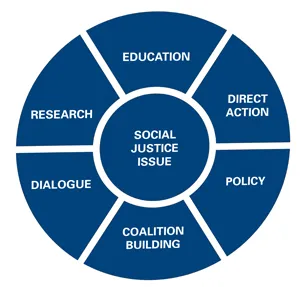
With a central issue – like food justice, poverty, immigration or education - CPS connects students, faculty and community members for action. Action takes on various forms and in six major focus areas: education, direct action, community building, policy, dialogue and research. The work for social justice is thus integrative and complementary, presenting a holistic approach to systemic change.
Program Areas
The Center for Public Service at Gettysburg College challenges students to “think critically and act compassionately” through six major program areas, carried out in partnership with students, community members, faculty and staff.
- Summer Fellowships — students immerse in community development initiatives in domestic and international locations
- Reflective Service — co-curricular opportunities for meaningful service.
- Community-Based Learning — integration of traditional classroom learning to hands-on experiences, challenging students to link academic theories with community realities.
- Community-Based Research — partnerships between students, faculty and community members to collaboratively engage in research to address a pressing community concern.
- Immersion Projects — travel opportunities in the U.S. and abroad for students to engage with a community, encounter challenges and deepen understanding of social justice issues.
Awards and Classifications
CPS is nationally recognized for its work building alliances between students, community members, faculty and staff to foster social justice.
- 2025 – Community Engagement Re-Classification from the Carnegie Foundation
- 2015 – Community Engagement Classification from the Carnegie Foundation
- 2014 – General Community Service Honor Roll with Distinction and the Education Community Service Honor Roll from the Corporation for National and Community Service
- 2013 – Presidential Awardee of the President’s Higher Education Community Service Honor Roll
Contact
Address
249 N. Washington Street
Gettysburg, PA 17325
Phone
On Social Media
Ready to Do Great Work?
