
Africana Studies

Critical approaches to better conceptualize and engage with the complex and distinctive experiences, lives, and contributions of peoples of African descent.
Students of Africana Studies experience alternative epistemological approaches, theories, and paradigms that enable them to better conceptualize, explain, and incorporate the contemporary interests and concerns of the majority of the world’s peoples and their societies.
Majors & Minors
| Program Name | Program Type |
|---|---|
Africana Studies |
Major Bachelor of Arts |
Africana Studies |
Minor |
Why choose Africana Studies?
The Africana Studies program is designed to cultivate critical thinking, cultural awareness, and a deep appreciation for the rich tapestry of African and African-descended communities. Our students are equipped with the knowledge and skills to:
- Understand historical contexts: Gain insights into the historical experiences and cultural developments of African and African-descended peoples.
- Analyze contemporary issues: Explore contemporary social, political, and economic issues affecting African and African diaspora communities.
- Promote social justice: Engage in meaningful discussions and actions that address issues of race, inequality, and social justice.
Why choose Africana Studies at Gettysburg
Opportunities
Africana Studies at Gettysburg offers a supportive, intellectually rich environment where students can develop their voices, broaden their perspectives, and prepare for meaningful careers and civic engagement.

Academics
Learn critical approaches that will enable you to better conceptualize and engage the complex and distinctive experiences, lives, and contributions of peoples of African descent throughout the Diaspora with an Africana Studies major or minor.

Community of Experts and Professors
The Africana Studies Program at Gettysburg College, originally African & African American Studies, was founded in 1986 with the support of Dr. Derrick K. Gondwe (Economics), Dr. William “Bill” Railing, Dr. Frank Chiteji (History), and President Charles Etzweiler Glassick (1977-1988).

Get Involved!
Students in the Africana Studies program at Gettysburg College can get involved with several campus organizations that celebrate identity, culture, and community engagement. These include the Black Students Union (BSU) - which advocates for Black student interests and cultural awareness, and the Gettysburg African Student Association (GASA), which provides a forum for discussions and events centered on African cultural, social, and political topics. There's also the Diaspora House (D-House) is a community space fostering connection and support for students of African descent and their allies on campus. These groups offer opportunities for leadership, cultural programming, and building community across diverse student experiences.
Internships
A wide range of internship and research opportunities are available to enable students to gain practical, professional, and academic experience beyond the classroom. These include the White House Internship Program, which offers hands-on work and leadership development in the Executive Office. The Summer Transportation Internship Program for Diverse Groups with the U.S. Department of Transportation, focusing on underrepresented students in transportation fields. Students can also engage in research-oriented internships like the Committee on Institutional Cooperation Summer Research Opportunities Program or internships with the Smithsonian Institutionand JPL Creative Evolution. These internship opportunities support career interests in public policy, law, science, international affairs and more.

Program Highlights
- Interdisciplinary approach: Our curriculum integrates multiple disciplines, offering a well-rounded perspective on Africana Studies. Courses cover topics such as African history, literature, politics, sociology, and the arts.
- Experiential learning: Participate in internships, study abroad programs, and community engagement projects that provide real-world experiences and enhance your understanding of Africana cultures.
- Dedicated faculty: Learn from passionate and knowledgeable faculty members who are experts in their fields. Our faculty are committed to mentoring and guiding students through their academic and personal growth.
- Research opportunities: Engage in independent research projects that allow you to delve deeper into areas of interest within Africana Studies.
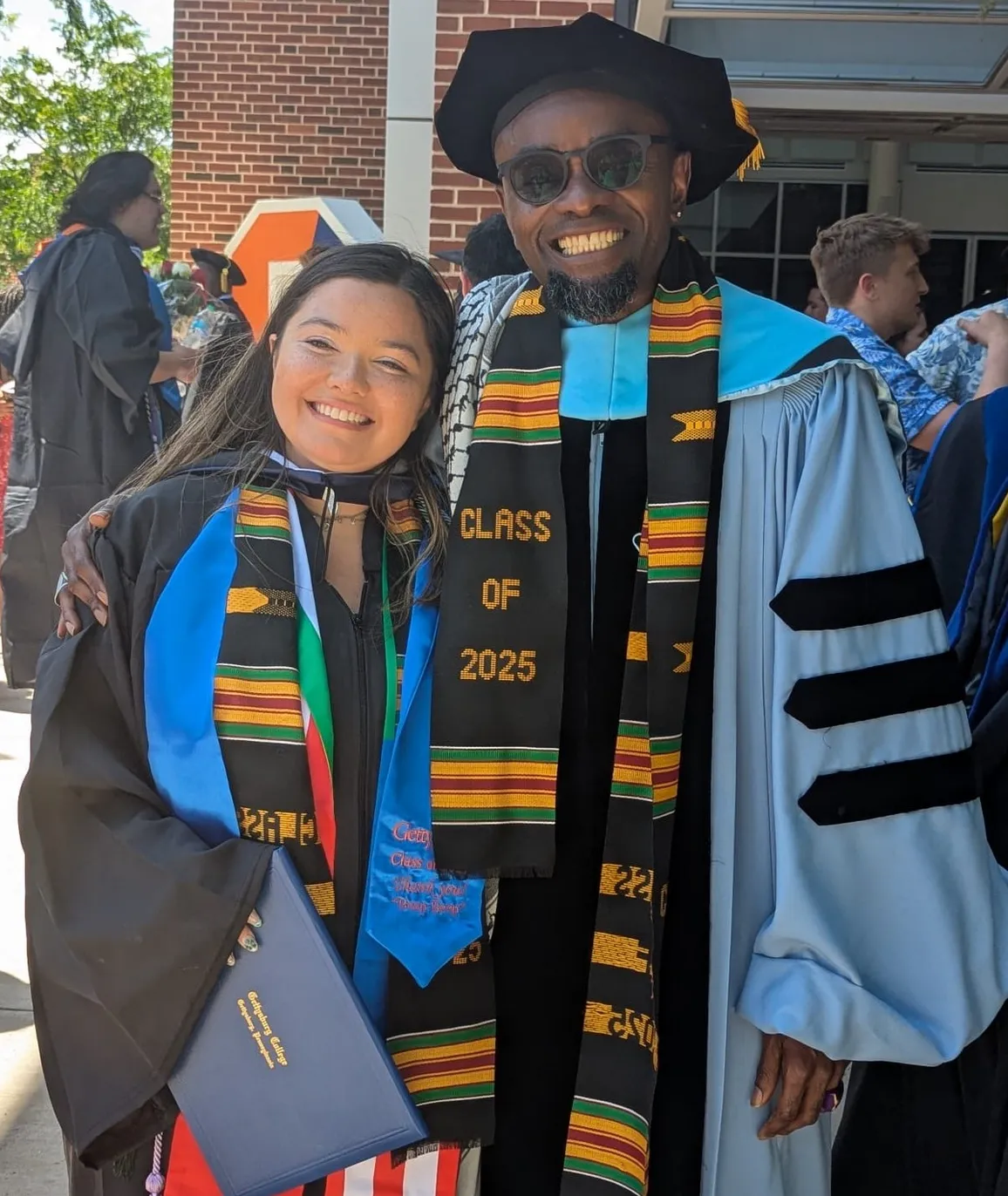
Dedicated faculty members, who are experts in their fields, offer personalized mentorship and support. This close-knit academic environment ensures that students receive the guidance they need to succeed academically and personally.
Our program encourages independent research, enabling students to explore topics of personal interest deeply. Through these research opportunities, students contribute to scholarly discourse and develop critical thinking and analytical skills.
Cultural enrichment activities, including guest lectures, film screenings, and festivals, further enhance the learning experience. These events celebrate the heritage of African and African-descended peoples, promoting a vibrant intellectual community and a deeper global understanding.
At Gettysburg College, we believe in the power of education to inspire you to "do great work." Our Africana Studies program equips you with the knowledge, skills, and experiences to make a meaningful impact in a diverse and interconnected world. Join us and discover how you can contribute to positive change and achieve greatness in your chosen field.
“Africana Studies has served as the black intellectual center on campus for the last 30 years”
– Jennifer Bloomquist, Chair of Africana Studies
Career Paths
A degree in Africana Studies opens doors to a variety of careers where cultural competence, analytical skills, and a commitment to social justice are valued. Graduates pursue careers in:
- Education: Teaching, educational administration, and curriculum development.
- Nonprofit sector: Community organizing, program management, and advocacy work.
- Public policy and government: Policy analysis, public administration, and international relations.
- Media and communications: Journalism, public relations, and cultural criticism.
- Business and law: Corporate social responsibility, human resources, and legal practice.




Africana Studies Events
The Forbidden Drum: We Begin
Peace and Justice Studies Meeting
Peace and Justice Studies Meeting
The evolution of the program is a testament to its enduring mission: to inspire students from all backgrounds to engage with diverse epistemological approaches, theories, and paradigms.
These intellectual tools help students better understand the contemporary interests, challenges, and contributions of black people from around the globe. In Africana Studies you will:
- Explore the varied expressions of traditional and contemporary African, African American, and Caribbean cultures.
- Re-assess the ways in which Africans and Afro-descendants engage with past and present social, economic, spiritual, and psychological realities in the United States, Africa, and the Caribbean.
- Establish a solid grounding in philosophical traditions, epistemological approaches, theories, and paradigms of people of African descent.
- Learn contemporary strategies for achieving justice and equality and enhancing life opportunities for people of African descent.
- Develop interdisciplinary skills of investigation, analysis, and communication.
Major and Minor Information
Ten courses are required for the AFS major.
Five Core Courses
- Two courses introductory courses from AFS 130, 131, 132
- One course on Sub-Saharan Africa from the following: AFS 233, 262, 321, 376, HIST 271, 272, 371, 373, 376, ECON 212 or other approved Africa-Specific course.
AFS 131 may be used if not taken as introductory course requirement - One course on the Caribbean from the following: AFS 225, 236, 238, 246, 251, 270, 274, 325, 346, 370, 374, LAS 223 or other approved Caribbean-specific course.
AFS 132 may be used if not taken as introductory course requirement - One course on gender from the following: AFS 248, 267, 274, ENG 258, WGS/ LAS/ ANTH 231 or other approved gender-specific course.
Intellectual History Course
- AFS 331 Africana Intellectual History
Capstone
- Senior Seminar/ Capstone: AFS 450, 460, 470
Three Africana Studies Elective Courses
- One 300 or 400-level AFS course, cross-listed or affiliated course
- Two other AFS, cross-listed or affiliated courses. May include ANTH 239, CWES 237, ECON 250, 253, EDUC 220, ENG 235,257, 236, 353, 362, FREN 331, HIST 106, 236, 238, 270, 272, 346, 364, 373, 375, 413, 424, MUS_CLAS 102, 110, POL 363, SOC 209, SYS 229, WGS/LAS 231. Must be approved by the AFS Chairperson.
Six courses are required for the AFS minor.
Two Core Courses
- One course from AFS 130, 131, 132
- AFS 331 Africana Intellectual History
Four Africana Studies Elective Courses
- One 300-level AFS course, cross-listed or affiliated course
- Three other AFS, cross-listed or affiliated courses. May include ANTH 239, CWES 237, ECON 250, 253, EDUC 220, ENG 235, 257, 236, 353, 362, FREN 331, HIST 106, 236, 238, 270, 272, 346, 364, 373, 375, 413, 424, MUS_CLAS 102, 110, POL 363, SOC 209, SYS 229, WGS/LAS 231. Must be approved by the AFS Chairperson.
Notes:
- Students should consult an Africana Studies advisor for guidance
- Students are permitted to select the Satisfactory/ Unsatisfactory option for one 100 or 200-level course counting toward the Africana Studies minor.
- No more than two courses can be at the 100-level
First Year Advising and Registration recommendations
Africana Studies at Gettysburg College offers the opportunity to learn how to analyze problems from a variety of disciplines such as economics, history, sociology, linguistics, music, political science, and literature. Africana Studies focuses on African American, Caribbean, Latin American, and continental African experiences, institutions, and perspectives. It is broadly defined as the study of people of African descent, with a goal of participating in the process of improving life opportunities for people of African descent as a part of working toward a more just world.
Common first-year courses
- AFS 130 Introduction to African-American Studies
- AFS 131 Introduction to African Studies,
- AFS132 Introduction Caribbean Studies
- Any 200-level AFS course
Available Courses
100 Level
Introduction to the study of the history and culture of various regions and groups in Africa. This course focuses on both the actual history and culture and how these have been portrayed from different intellectual perspectives. Topics covered include, African philosophical beliefs; an examination of the slave trade, the participants and its impact; political traditions and systems in Africa; economic systems and the impact of, and resistance to imperialism.
Sunny skies, white sands, and mixed drinks with a dash of Bob Marley: that's the image many have of the Caribbean. Once the preeminent site of imperialist expansion and a major cog in the development of capitalism, the Caribbean now sits at the margins of the global economy. This multi-disciplinary course will traverse a geographically tiny, yet politically, historically, and culturally rich terrain. This course seeks to enliven the many other aspects of life in the Caribbean outside of tourism; it will commence with the historical influences of the Indigenous peoples as well as the colonizers, and cover contemporary issues such as international and sustainable development, climate change, race-based politics, and syncretic art forms and religions.
Investigation of the variety of English referred to as African American English (or Ebonics) with specific focus on the following areas: grammatical structure, pragmatics, history, and educational issues.
Consideration of African Americans within the broader context of the African Diaspora. Students are introduced to a broad range of themes in their historical context, from the African origin of world civilization to the formation of African American societies and cultures. Other themes include the enslavement of Africans, rise and fall of slavocracy, Civil Rights and Black Power struggles, and the emergence of African-centered scholarship and praxis.
200 Level
Investigation of the variety of English referred to as African American English (or Ebonics) with specific focus on the following areas: grammatical structure, pragmatics, history, and educational issues.
An exploration of the educational consequences of linguistic and cultural diversity and a broad overview of sociolinguistic topics, with the goal of introducing students to current issues in the field. Topics include language contact and language prestige, multilingualism and bidialectalism, communicative competence, language and social identity, code switching and diglossia, language socialization and language ideology and their consequences for educational policy and practice.
Globalization is one of today’s buzzwords. It is at once everywhere and sometimes nowhere. It is a maddening nexus of seeming contradictions. Although the course utilizes the Caribbean as a case study for many of the issues pertaining to globalization processes, it also pays close attention to global forces that connect seemingly divergent locales. In essence, from week to week, the course shifts from the macro to the micro and back. This affords a more comprehensive sense of the complicatedness of both the homogenizing trajectory of globalization as well as the disjunctures it engenders. The course spans disciplines and topics such as history, political economy, sociology, international relations, culture, media, (im)migration, environment, race, class, and gender.
After World War II, decolonization gained momentum across the world, and in its wake, emerged many newly-minted sovereign nation- states. Most countries in the Caribbean became independent in the 1960s, yet the Caribbean has remained a geo-political space demarcated by rupture, fragmentation and disjuncture. Myriad races/ethnicities (including indigenous, European- mostly English, Spanish, French, Dutch-, Africans, Indians, Chinese, Syrians and Lebanese) came together in the Caribbean under the rubrics of colonialism, slavery and indentureship. In this course we will spend considerable time exploring many theories of postcoloniality around the world, then connect them to various fragments of postcolonial life in the Caribbean, centering on issues of race/ethnicity, gender and identity.
A study of how U.S. law has dealt with African Americans and Women, from their status as property to the current cases about affirmative action and 'reverse discrimination.' Includes an introduction to Critical Race Theory and Critical Feminist Theory as approaches to viewing the law. Each student will work with their own Supreme Court case, wrestling not only with the legal concepts contained in the case, but the historical context from which it arose, with both a broad (national) and local (parties to the case's community) focus, as well as who represented whom and how were they paid, applying theory in a direct and practical fashion. Offered as staffing permits.
This course explores how schooling has made us the people that we are today, and asks if formal education has prepared us for the challenges that we face in this age of globalization. The course assaults the status quo nature of education and challenges us to imagine a pedagogy that is central to social change. This interrogation of education is not meant to raze the entire historical edifice to the ground, but rather to lead us to critically reflect on the far too frequent manifestations of dull educational processes that produce conformists, rather than inspire us to creatively overturn structures of inequities. AFS 264 and EDUC 264 are cross-listed.
A critical examination of the literary, filmic, historical, and memorial representations of Africa. The course traces and analyzes the politics that informs the cultural constructions of Africans as people who live in particular spaces and times. The course compares various African(ist) literary, cinematic, and historical traditions and maps out the areas of convergence and differences as far as the representation of Africa is concerned. Engaging with history as a discipline, it highlights alternative ways in which intellectuals and laypeople have laid claim to the interpretation of the African past. Finally, moving away from Euro-centrism, the course emphasizes cultural productions of African writers, film directors, and public historians to show that Africans are not just subjects of history; they are equally agents of historical representation in its various guises. AFS 262 and HIST 273 are cross-listed. Offered as staffing permits.
In this course, we explore the economic history and development of Africa, focusing on theories, methods, empirical analysis and key debates. We examine the external and internal, institutional and resource-based explanations of the region's development from pre-colonial period to the modern economy. We will consider the role of development practitioners such as international financial and trade institutions, nongovernmental bodies, and global governance institutions.
Africa is a large and diverse continent, better understood through an appreciation of individual country development experiences – many countries on the continent remain underdeveloped while others have achieved emerging status. As such, we will make use of country case studies and current events to better understand the differences and similarities of the effects of both policy responses, resource and institutional constraints. Prerequisite: ECON 103 and 104; ECON 241 recommended. AFS 256 and ECON 256 are cross-listed.
This course explores the rigorous study of the relationships between sound and culture in different contexts. It assumes a cultural perspective toward music making to understand the social dimensions of music creation, practice, and dissemination. The course uses methods such as sound embodiment and critical analysis as well as theoretical frameworks from various disciplines such as linguistics, anthropology, acoustics, psychology, and sociology. Previous topics in this class include "Music from the Caribbean" and "Latinx Musics." MUS 251, AFS 251, and LAS 251 are often cross-listed in various combinations depending on the topics offered.
Survey of poems, essays, novels, short stories and plays written by African American women. Starting with late 18th century poet Phillis Wheatley and ending with 1993 Nobel Prize Laureate Toni Morrison, we investigate the political, social, and aesthetic concerns with which these women writers contend: spiritual conversion; woman's labors under slave bondage; reconstructing the womanhood and family ties in the post-Emancipation Era; protest against racist violence, specifically lynching and rape; black women's moral reform movement; racial passing and socioeconomic mobility; government challenges to black women's reproductive rights; and collaborative methods to organize black women-centered communities. Cross-listed with AFS-248. Offered occasionally. Fulfills humanities and conceptualizing diversity requirements.
A survey of the history of African American music in the United States, beginning with a perusal of music in Africa and the Caribbean and tracing its development from spirituals to hip-hop. Disciplinary perspectives range from ethnomusicology (the study of music in its cultural context) to anthropology, religious studies, critical race theory and gender studies. No previous academic experience with music is required. Cross-listed with AFS 247.
“Everyone has the right to leave any country”; “Everyone has the right to work and to receive equal pay for equal work”; “Everyone has the right to education”: These are excerpts from the Universal Declaration of Human Rights (UDHR), a document adopted in 1948. This course involves exploration of the rise and spread of human rights; various human rights policies and practices in different parts of the world, with an emphasis on the Caribbean.
Jazz is appropriately considered to be African American classical music because 1) its major innovators are black; 2) it is acknowledged as a uniquely American art form, and, 3) like European and Asian classical musics, it stresses virtuosity, is performed by professionals, and (nowadays) is meant primarily for listening. This course surveys the development of jazz in relation to African American history and aesthetics, addressing socio-political contexts as well as musical style. AFS 244 and MUS_CLAS 244 are cross-listed.
Exploring the diverse, complex, and coercive forms of enslavement from European contact to the beginning of the American Civil War---This is the line of inquiry that runs through this course. Recovering the experiences of the enslaved offers students an opportunity to see how systems of oppression did not mute black voices. Primary sources, especially memoirs, are essential to this class. Material and visual culture of enslaved people also figures prominently in class research projects. Racial theory provides students a chance to see how ideologies of oppression arise out of specific, but changing historical circumstances, a critical learning goal of this course. CWES 240 and AFS 240 are cross-listed.
Study of the evolution of the Caribbean people from colonial to post-colonial times through careful reading of literature. Course includes novels from the English, Spanish, and French Caribbean. A small and accessible body of post-colonial theory supplements the works of fiction. Focus is on the different political, economic, and cultural realities imposed on the various islands and their populations by the respective colonizing powers. AFS 236 and LAS 223 are cross-listed.
A study of Francophone African literature by major women authors. The course covers themes pertinent to the contemporary representation of African society and women’s place in it. A small and accessible body of post-colonial and critical theory supplements the works of fiction to help place the novels in their literary and cultural context.
Pop culture provides us with the stories, images, and scripts that enable us to imagine and practice racial identities. These images and practices, in turn, are imbued with gender and sexuality values and characteristics as well. The racial and ethnic norms generated by popular culture are reproduced in the ways in which audiences both perform and navigate racial terrain in their own lives. Media consumers absorb these norms in the ads they see, the movies/television they watch, and the music they listen to. This course enables students to do critical thinking about these images, practices, and stories. AFS 215 and CIMS 215 are cross-listed.
Rigorous, detailed examination of the philosophical and intellectual traditions that shape a common social heritage shared by Africans and African Americans. Course assumes a cultural perspective toward human organization to understand the social dimensions of the historical and contemporary ordering and governance of the African life by systems of religious, economic, and educational thought. Fulfills either the Global Understanding or Conceptualizing Diversity requirement.
300 Level
Examinations of the political, cultural, historical, or economic experience and expressions of the people of the African Diaspora. Fulfills either the Cultural Diversity Domestic/Conceptual or Nonwestern Goal
A critical examination of the rise and evolution of the shared, but also contested, history between France and the nation-states that once formed France’s empire in Africa south of the Sahara. The course will begin by briefly introducing the French colonial expansion in Africa in the late 19th century and mapping out its geographic contours. Offered as staffing permits. AFS 376 and HIST 376 are cross-listed.
A critical examination of the evolution of foreign aid provision and volunteering in Africa. The course analyzes the international and transnational politics of assisting Africans in their quests for a better life. The course also examines the various ways in which aid provision and volunteering have constructed Africa as the ultimate “paradigm of difference.¿? It assesses the impact of aid and volunteering on African societies and investigates the possibility of alternative approaches to aid provision. The course finally explores how Africans have historically been instrumental in the development/modernization of their respective societies. AFS 375 and HIST 375 are cross-listed. Offered as staffing permits.
Globalization is one of today’s buzzwords. It is at once everywhere and sometimes nowhere. It is a maddening nexus of seeming contradictions. Although the course utilizes the Caribbean as a case study for many of the issues pertaining to globalization processes, it also pays close attention to global forces that connect seemingly divergent locales. In essence, from week to week, the course shifts from the macro to the micro and back. This affords a more comprehensive sense of the complicatedness of both the homogenizing trajectory of globalization as well as the disjunctures it engenders. The course spans disciplines and topics such as history, political economy, sociology, international relations, culture, media, (im)migration, environment, race, class, and gender.
Study of the impact of European colonial rule on African cultures, African responses to colonialism, and the impact of the colonial experience on contemporary African nations. Course also examine various methods of African resistance to colonial rule. Offered as staffing permits. AFS 373 and HIST 373 are cross-listed.
This course offers an in-depth study of the interaction between law in America and its most adversely affected subject: black men. From slavery to the death penalty, from cocaine sentencing to hate crime prosecutions, no other group has been punished more. In the practice of law, while other groups suffer from a glass ceiling, for black men it is bulletproof Plexiglas. This course will address the causes, conditions, and consequences of this separate and unequal treatment of black men by the law. Offered as staffing permits.
Examinations of the political, cultural, historical, or economic experience and expressions of the people of the African Diaspora. Topics numbered 348 fulfill cultural diversity domestic conceptual, 349 fulfill cultural diversity nonwestern and 350 fulfill either goal.
“Everyone has the right to leave any country”; “Everyone has the right to work and to receive equal pay for equal work”; “Everyone has the right to education”: These are excerpts from the Universal Declaration of Human Rights (UDHR), a document adopted in 1948. This course involves exploration of the rise and spread of human rights; various human rights policies and practices in different parts of the world, with an emphasis on the Caribbean.
Exploration of the evolution, links, and applications of black thought in the Atlantic World. Efforts toward political, economic, and social change in the African Diaspora are examined through the lenses of various ideologies and historical contexts, such as black emancipation and nationalist movements, black and African feminism, and global expansion of hip hop culture. Students conduct extensive analysis and discussion of oral traditions and primary writings, stretching from Sundiata to C. L. R. James, Sojourner Truth to Franz Fanon, and Frederick Douglass to Angela Davis. AFS 331 and HIST 274 are cross-listed. Offered every other year.
A study of Francophone African literature by major women authors. The course covers themes pertinent to the contemporary representation of African society and women’s place in it. A small and accessible body of post-colonial and critical theory supplements the works of fiction to help place the novels in their literary and cultural context.
An interdisciplinary perusal of issues surrounding Africana musics ranging from African music such as juju to Afro-Caribbean styles such as salsa and African American forms such as jazz and hip-hop. This discussion-oriented course calls upon perspectives from Africana studies, ethnomusicology (the study of music in its cultural context), anthropology, religious studies, history, philosophy, critical race theory, gender studies, and literary criticism. Cross-listed with AFS 318.
400 Level
Intensive culminating experience for Africana Studies majors. Under the direction of a faculty member, students work to integrate their major and their understanding of the field(s) of Africana Studies. Prerequisite: AFS 331. The course reinforces students’ understanding of the intellectual foundations and theoretical frameworks that shape the field(s) of Africana Studies, informs and sharpens their awareness of current scholarly debates in Africana Studies, provides an opportunity for student collaboration in constructing reading lists and devising project methodologies, and builds intellectual accountability among students and faculty.
Individualized tutorial counting toward the minimum requirements in a major or minor, graded A-F
Individualized research counting toward the minimum requirements in a major or minor, graded A-F
Individualized research not counting toward minimum requirements in a major or minor, graded A-F
Internship counting toward the minimum requirements in a major or minor, graded A-F
Summer Internship graded A-F, counts for minimum requirements for a major or minor only with written permission filed in the Registrar's Office.
Summer Internship graded S/U, counts for minimum requirements for major or minor only with written permission filed in the Registrar's Office.
Half credit internship, graded S/U.
Africana Studies

More In Africana Studies
Ready to Do Great Work?
