
Japanese Studies

Expand your understanding of the world by studying its most populous continent.
It's the birthplace of some of its oldest civilizations and most exciting contemporary pop cultures. As an East Asian Studies major or minor, with a concentration in either China or Japan, your studies will take an interdisciplinary approach to exploring the region.
Majors & Minors
| Program Name | Program Type |
|---|---|
East Asian Studies Major – Japan |
Major Bachelor of Arts |
Japanese Culture |
Minor |
Japanese Language |
Minor |
Why choose Japanese Studies?
As a student of foreign language and culture, you will have developed skills and concepts that are relevant to every area of employment. Knowledge of the Japanese language is very useful in business, the social sciences, engineering, economics, public administration, the civil or foreign services, government, and teaching, and the ability to communicate on a multicultural level is highly valued both domestically and internationally.
Why choose Japanese Studies at Gettysburg
Opportunities
Join other students in an immersion of Japanese culture, language, literature, and more.

Academics
Gettysburg College upholds the goal of developing lifelong learners who are prepared for the responsibilities of local and global citizenship.

Community of Experts and Professors
Meet the faculty who will guide you through your interdisciplinary Japanese Studies journey.

Many resources are available to help you in your pursuit of a Japanese Studies major.
Japanese Language Table
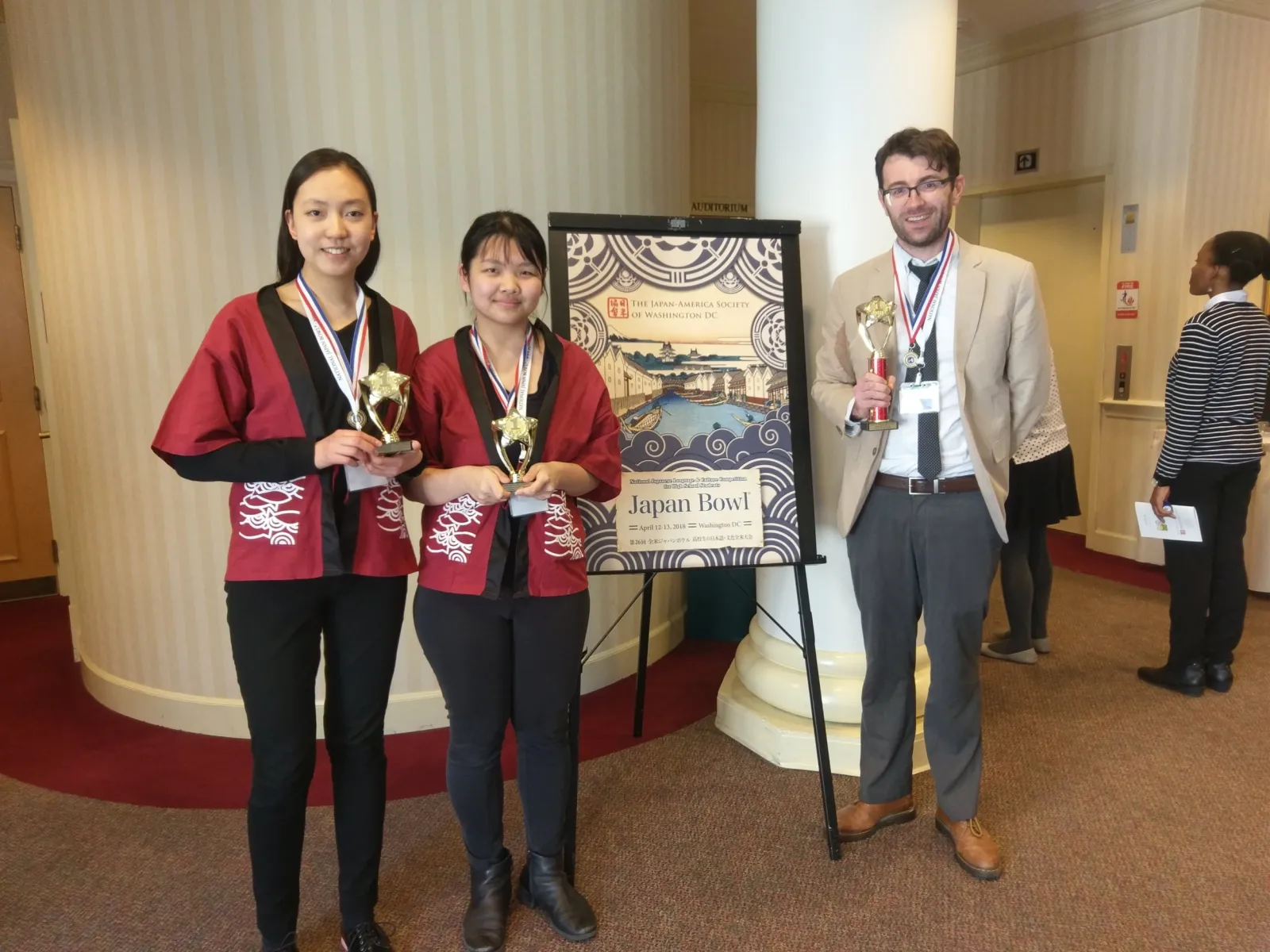
Practice casual Japanese conversation at the Japanese Language Table! Bring your lunch and chat with other students and at least one native speaker over the lunch hour, once a week in the Grille. Go through the Dining Center using your ID and then sit at the reserved space in the Grille. Note: outside food cannot be brought into the Atrium.
Japanese language resources
- Japanese language proficiency test. The Japanese-Language Proficiency Test (JLPT) is a test for non-native speakers of Japanese which evaluates and certifies their Japanese-language proficiency.
- Japanese dictionary. Jisho is a powerful Japanese-English dictionary. It lets you find words, kanji, example sentences, and more—quickly and easily.
Study abroad
Gettysburg College is affiliated with two programs for studying abroad. Both universities offer instruction in Japanese language and a full range of courses on Japanese topics in English. Students may also choose to attend other universities in Japan.
On-campus resources
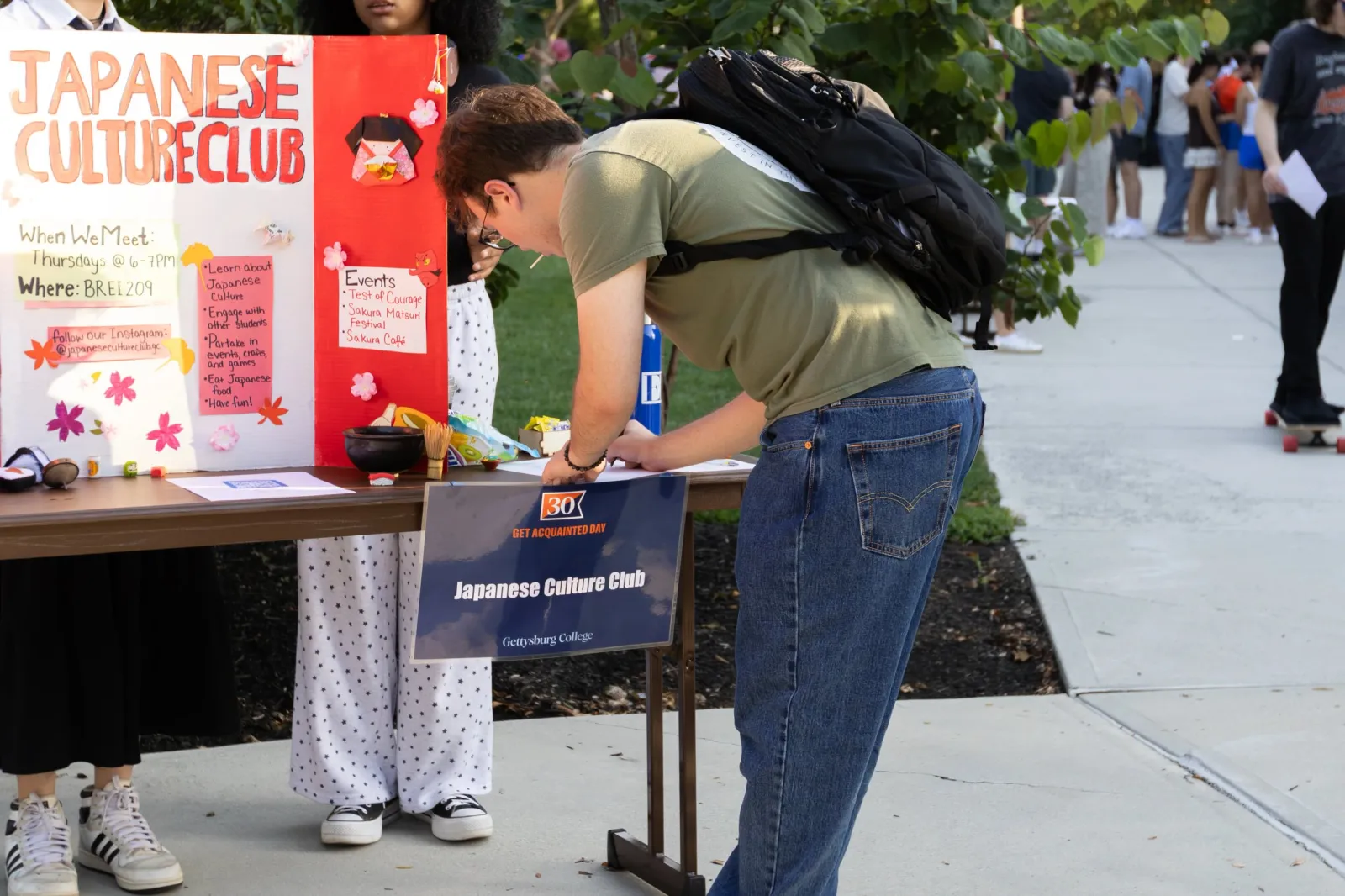
Student organizations
Asian Student Alliance
The Asian Student Alliance at Gettysburg College strives to provide the campus with a community to discuss, exchange, and share Asian student interests, issues, and experiences.
Japan Club
Japan Club meets regularly to spread awareness and a sense of community by introducing its members to Japanese culture, products, and language.
International Club
The mission of the International Club is to promote a multicultural exchange of perspectives between international and American students, faculty, administrators, staff, and members of the local community.
Musselman Library Asian Art Collection
Includes some 2,000 objects from across Asia, ranging from approximately 1700 BCE to the 20th century.
Center for Career Engagement
The on-campus source for networking, internships, career counseling, and much more.
After graduation
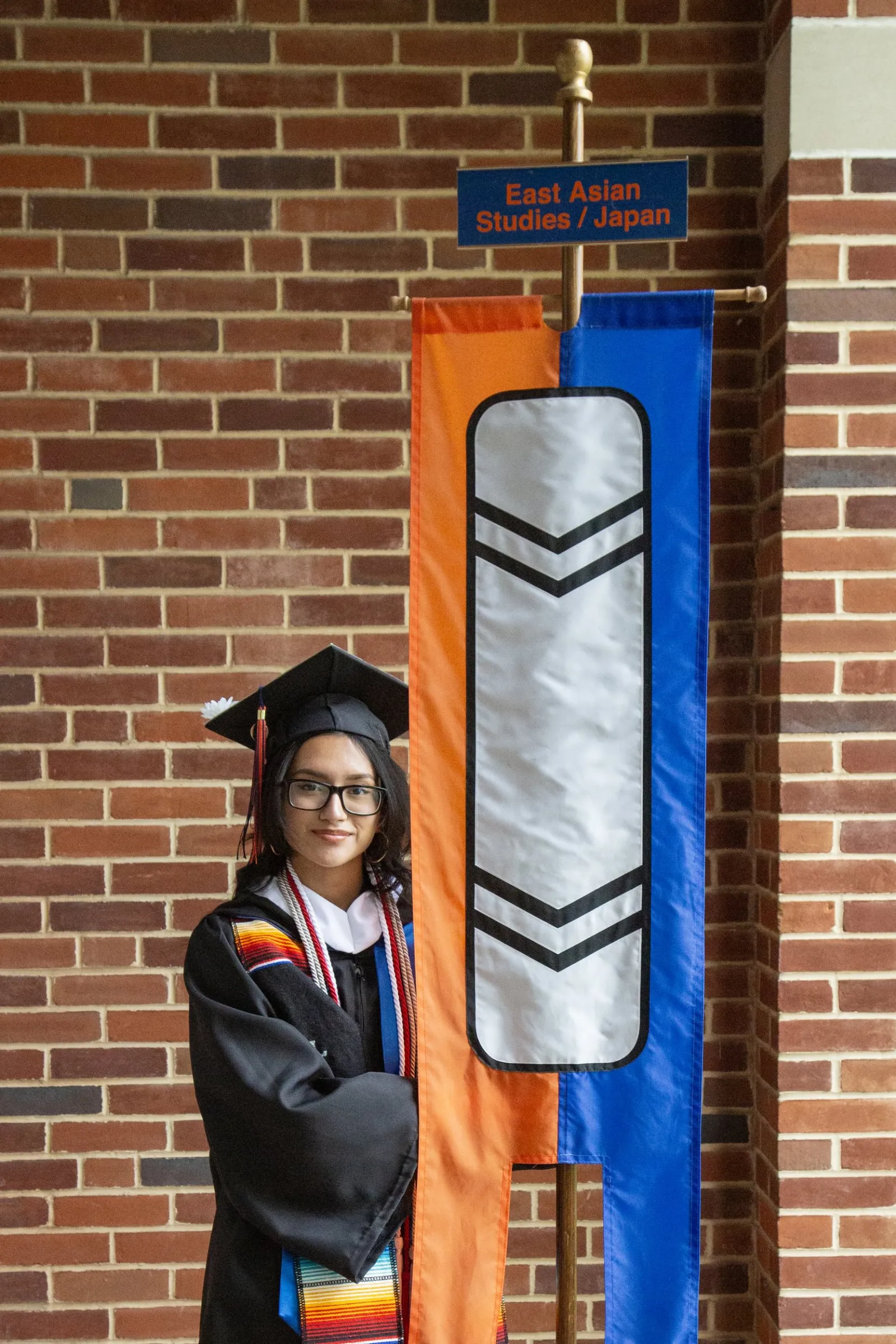
What can I do with a B.A. in Japanese Studies? This blog began as a collective effort of Gettysburg College students who graduated with a B.A. in Japanese Studies, and has expanded to include bloggers from other institutions and companies who have been in the Japan field.
- JET Program After graduation, many Japanese majors and minors teach English in Japan. The JET program is highly respected. Representatives from JET come to Gettysburg College each fall.
Japanese media
Institutions and organizations
Festivals
The Japanese Studies major and minor are interdisciplinary in nature.
Students gain a broad understanding of the language, culture, literature, history, art, film, music, theatre, religion, and politics of Japan.
Major and Minor Information
Ten courses and a global study experience are required for the EAS – Japan major
Core Courses
- AS 110 Japanese Culture & Society
- AS 110 is recommended for first- and second-year students, but cannot be taken by those who have studied in Japan, a petition to the EAS department is required to take a substitute course.
- JPN 102 Elementary Japanese
- JPN 201 Intermediate Japanese I
- JPN 202 Intermediate Japanese II
- JPN 301 Advanced Japanese
Four Japan-related Major Electives
One course must be history. At least one must be non-language course at the 300-level taken at Gettysburg College. No more than two courses at the 100-level. May include one Japanese language course beyond 301.
- Option A: HIST 222 East Asian History:1800 to present (Gettysburg College) and 3 Japan related courses, OR
- Option B: KGU 250 Japanese History (taken in Japan), One East Asian Comparative course, and two Japan related courses
Capstone Experience
- AS 400- level course taken in the form of the seminar or an independent study
It is recommended this be completed in the senior year.
Notes
- Global Study is typically required, but exceptions via petition to the EAS department may occur.
- Global Study courses cannot count as 300-level non-language courses.
- If a student places out of a required language course(s), they must substitute a course(s) to ensure a minimum of TEN courses for the major via EAS department approval
- If studying abroad for a semester, three courses may be counted toward the major
- If double-majoring, no more than three courses can count for both majors
Six courses are required for the minor.
Core Course
- AS 110 Japanese Culture & Society
Must be taken at Gettysburg College. - AS 110 is recommended for first and second year students, but cannot be taken by those who have studied in Japan.
Three Elective Courses*
- One from Arts & Humanities
- One from History & Social Science
- One additional course
Comparative
- One course that offers a comparative perspective with East Asia or focuses on China
Language
- JPN 201 Intermediate Japanese**
Notes
*Categories and potential courses for the electives appear on the Japanese Track Requirements webpage.
**JPN 101 & 102: Elementary Japanese are pre-requisites for JPN 201 bit do not count towards the minor, However, student who have previously studied Japanese may enter the 200-level as determined by the language placement exam. Japanese language proficiency at the 202 level is required and determined by the department.
Six courses are required for the minor.
- AS 110 Japanese Culture & Society
(must be taken at Gettysburg College) - Five language courses JPN 102 and higher
*JPN 101 does not count towards the minor
First Year Advising and Registration recommendations
Before you register
- Students with prior Japanese or Chinese study must take the online placement exam before registering for a language course. Access it through the First-Year Dashboard. If the Dashboard has closed, contact Prof. Jing Li (Chinese) or Prof. Eleanor Hogan (Japanese) for access.
- Borderline scores will receive a follow-up email; an interview may be held during Orientation Week to finalize placement.
- All East Asian Studies majors are expected to study abroad in Japan or China at some point during their college career.
Common first-year courses
Culture and society (recommended for all students)
- AS 111 Chinese Culture and Society
- FY-W 113 Warriors, Enchantresses, and Beasts (also fulfills First-Year Writing requirement)
- FY-W 149 Japanese Pop Culture Goes Global (also fulfills First-Year Writing requirement)
Majors and minors specialize in either Japan or China and should take the relevant course in their first or second year.
Language (no prior experience required)
- JPN 101 Elementary Japanese (meets 3 days/week)
- CHN 101 Beginning Chinese (meets 3 days/week)
Available Courses
100 Level
An introduction to the culture and society of China, exploring themes, issues, and institutions in China, as seen through the lens of Chinese culture. The course investigates how Chinese culture evolved within the changing socio-political milieu from early state formation (~10th c. bce) to the present. Major topics include cultural notions used in the construction of self, family, education, work, and religious practice. Students acquire the skills and mindset to facilitate the study of China, a non-western culture, in a culturally appropriate manner. Readings in English.
This course explores 'uncomfortable' topics in the complex 150-year relationship between Japan and the U.S., focusing on key issues, such as racial stereotypes, immigration, the Japanese Exclusion Act, atomic bombings, internment camps, U.S. military bases in Japan, sexual objectification of East Asian women, and anti-Asian hate during COVID-19. Students will examine the dynamics of racism, power, and privilege in both nations, using English-language readings and alternative perspectives from Japanese scholars. This course is conducted in English.
A survey of the Arts of Asia from Neolithic period to Modern times. Three general topics, including Ancient Civilization, Asian Religion and Art, Traditional China and Japan will be discussed. The course covers different art forms primarily painting, sculpture and architecture from several regions: India, China, Japan, Central Asia and Southeast Asia. The works of art are important in their own contexts and we want to learn what they reveal about their parent cultures. Offered every semester. ARTH 131 and AS 131 are cross-listed.
Introduction to the fundamentals of speaking, listening, reading and writing. Students master hiragana and katakana and learn basic Chinese characters as they are used to write Japanese. Students shop for various items, describe objects, use counters, ask prices, and hold basic conversations all in Japanese. The course also acquaints students with basic patterns, ritual greetings and phrases, and cultural aspects embedded within the use of language.
This introductory course explores themes, issues, and institutions in Japan, offering insights into Japanese culture from a Japanese perspective. We will examine how experiences and interpretations shape contemporary Japanese identity. The course includes a historical survey and discussions on modern Japan, covering topics such as the origins of the Japanese people, language, culinary traditions, warrior ideals, religious practices, folktales, creation myths, anime, manga, World War II issues, fashion, family, education, and career. No prior knowledge is required. Readings are in English.
Introduction to the fundamentals of speaking, listening, reading and writing. Students master hiragana and katakana and learn basic Chinese characters as they are used to write Japanese. Students shop for various items, describe objects, use counters, ask prices, and hold basic conversations all in Japanese. The course also acquaints students with basic patterns, ritual greetings and phrases, and cultural aspects embedded within the use of language.
200 Level
Study of traditional Japanese theatre, focusing on Noh, Bunraku Puppet Theatre, and Kabuki from the fourteenth century to the present. The course examines major theories and a variety of representative plays of the three theatrical forms and investigates their artistic, religious, and socio-cultural significances. Emphasis is on adaptation of literary canons, treatment of convention, seminal playwrights, and performance styles. Instruction in performing Noh chanting and dancing unites theory and performance to deepen understandings of the non-western tradition. Readings in English
Students learn and reconstruct what daily life was like in Gettysburg and Tokyo in the 17th–19th centuries using the approaches and methodologies of household archaeology. This course uses different lines of evidence, such as material culture from domestic contexts and textual and scientific evidence from relevant archaeological and historical sites. Students explore various themes, including household composition, production, identity, inequality, cooking, gender relation, and religious faith. AS 252 and ANTH 252 are cross-listed.
Examination of a variety of Japanese women writers, genres, and movements ranging from 800 to 2002. Using feminist and other literary criticism, the course analyzes the category Joryubungaku (women's literature) and its import in relation to the Japanese literary canon. Authors include Murasaki Shikibu, Enchi Fumiko, Nogami Yaeko, Machi Tawara, and Yoshimoto Banana. Readings in English.
This course explores the beliefs, ritual practices, and material culture of Shinto and Buddhism in Japan as well as those of Shugendo, “new religions", myth, folklore, Yokai, and urban legends. It examines how the Shinto- and Buddhism-derived beliefs, practices, and stories are shown in visual media (anime, films, manga, video games). Students learn to critically interpret how these media representations are perceived by the targeted audience in Japan and across the world. AS 253 and REL 253 are cross-listed.
Study of modern literary and cinematic representations of coming of age in China, Korea, Japan, Taiwan, and Vietnam. Students examine how characters learn to navigate their worlds, overcome obstacles, and mature. Focal points are: gender; income level, education, and cultural and national history related to internal and external conflict, modernization, occupation, or relocation. Texts include graphic novels, animated films, short stories, novels, and feature films. Readings in English.
Introduction to Japanese studies as an interdisciplinary subject. Students study a prominent literary text (Tale of Genji or modern novel) and the various literary methods for analysis while also being introduced to other disciplinary methods, including history, art, anthropology, drama, translation studies, women's studies, and religion.
Examination of the cultural development of Japan in various disciplines. Students investigate and analyze the topic from various perspectives using a variety of texts and visual documents to construct a framework that encompasses disciplines such as politics, religion, language and literature, art, and theatre. Students develop an understanding of the research methods and critical theories relevant to these disciplines and the topic, and a mastery of effective communications skills.
This is an introductory Korean Politics course. Starting from the division of Korean peninsula, we analyze the economic development, state repression and coercive institutions in two Koreas. We explore how South Korean citizens pursued democratization through social movements and how North Korea successfully facilitated power succession within one family for three generations. We survey the nuclear weapon development in North Korea and students will simulate the Six Party Talk to deepen their understanding on the issue. Prerequisite: POL 104. AS 273 and POL 273 are cross-listed.
A language course to prepare students for a possible major or minor in Japanese Studies. The course presents grammar and vocabulary at a faster pace and in broader topics and situations than in the traditional intermediate language course, in order to obtain higher proficiency in both conversation and reading/writing. Also, the course introduces students to skills for beginning independent research and study of materials of their own interests in the field of Japanese Studies.
Extension of beginning Japanese. Building on the basics, the course emphasizes communication. Students learn to ask and give directions, use honorific and humble verbs, conduct interviews, and discuss family and work situations. Chinese characters (kanji) are introduced at a more rapid rate, and students are able to read and write simple texts and some authentic materials.
Extension of beginning Japanese. Building on the basics, the course emphasizes communication. Students learn to ask and give directions, use honorific and humble verbs, conduct interviews, and discuss family and work situations. Chinese characters (kanji) are introduced at a more rapid rate, and students are able to read and write simple texts and some authentic materials.
Anyone can be a hero—old, young, female, male, and non-human. Through readings on psychology and culture, we study heroic perceptions as we follow the various permutations and intersectionalities of Japanese heroes in literature, film, anime, manga and video games, beginning with a hero first appearing in print in 712 who is still “alive” today in various media. Readings in English. Viewings in Japanese and English. Japanese sources available.
Study of various permutations of the science fiction genre-legends, fairy tales, myths, supernatural and futuristic short stories, and novels. Major emphasis is on Japanese works, with cross-cultural comparisons to offer diverse perspectives. Course focuses on the literary analysis of the individual texts, while exploring the real purpose served by these unreal creations. Reading in English.
Study of various genres of literature from the Meiji Period (1868-1912) to the present, which includes both "pure" and "popular" works. Genres include diaries, plays, and various kinds of novels such as the "I-novel," lyrical novels and modern thrillers. Seminar format with intensive reading and writing in Japanese and English at an advanced level. Authors to be read include Ishikawa Takuboku, Yasunari Kawbata, Kirino Natsuo, and Murakami Haruki.
Survey of Japanese literature, beginning with the creation myth recorded in 712 and continuing to the dramatic arts of the 1600s. Course examines legends, folk tales, fairy tales, poetic anthologies, diaries and fiction. Lecture/ discussion format. Readings in English; no knowledge of Japanese required.
A study of Chinese painting and the art forms that have long held prestige positions in Chinese art. This course is intended to introduce the students to artistic practices created by both professional artists and scholar-painters. Class lecture and discussion focus on painting, the history of collections, theories on connoisseurship and aesthetics from the 3rd c to modern times. The interplays between painting and poetry, philosophy and politics are emphasized. Ink and brushworks is also analyzed and demonstrated in class. ARTH 235 and AS 235 are cross-listed.
This course examines how objects and images illuminate the cultural history of China from the late Neolithic period to the twentieth century. Recognizing China as an evolving geographic and cultural entity, the course approaches artworks from an interdisciplinary perspective, drawing on art history, archaeology, anthropology, and cultural studies. Students explore how objects and images both shaped and were shaped by Chinese and foreign ideas about identity, power, belief, and everyday life, and learn to interpret visual and material forms as carriers of meaning and as windows into China’s social, political, and cultural history. Open to First Year Students. Offered once a year. ARTH 234 and AS 234 are cross-listed.
This course introduces students to some of the representative works of Chinese literature. More importantly, it helps students understand and reevaluate the concepts of China, Chinese people, and Chinese literature. Discussions include questions such as: "What is China (the Middle Kingdom)?" and "What does it mean to be Chinese?" The works discussed explore a variety of topics, and all highlight the volatile interactions between the representation of Chinese identity and their cultural contexts.
Study of Chinese and Japanese cultures and societies from a comparative perspective. This course explores the transnational connections between the two East Asian countries from premodern times to the contemporary. By studying the similarities and differences in various social and cultural topics and issues between China and Japan, students examine and compare the core values and identities of the two cultures. The course prepares students for further study in China and/or Japan. All readings are in English.
China: 30 Years in Literature and Film aims to familiarize students with key issues in contemporary China through the medium of literature and film. Key issues and topics include memory and trauma, modernization and globalization, youth and popular culture.
Study of the history, transformation, and practices of Chinese folklore both in China and Chinese communities abroad. Focus is on the rich repertoire of Chinese folklore; its representations in literature, pop culture, daily life, and political discourse; and its significant roles in shaping ideas about morality, nation, gender, ethnicity, and heritage; its contribution to the spread of religion, the pursuit of status, and the achievement of modernity. The course helps students to understand the ways Chinese at the grass-roots level live and think.
In the 30 years after the end of the Cultural Revolution (1966-76), the literary world of China has undergone various changes that mirror and anticipate social and political shifts. In this course we will read representative works of the so-called scar literature, reflection literature, reform literature, avant-garde literature, new realist literature, and modernist literature. Authors include mainland writers Yu Hua, Mo Yan, Su tong, Wang Anyi, Wang Shuo, Wang Meng, Chi Zijian, as well as Chinese expatriates Gao Xingjian, Ha Jin, Yan Geling, and Dai Sijie. We will also watch a few films that are based on some of the readings for this class.
Study of the history, uses, and reshaping of folktales and fairy tales in the oral, literary, and filmic traditions of both the Western world and China. Focus is on the underlying forces and reasons for the radical transformations of these tales in form and meaning; their significant roles in constructing nation, ethnicity, class, gender, and morality; and their nature as an art form of questioning the larger culture. It introduces the methods of narrative analysis and cultural criticism in folktale research.
Study of the literary and bodily encounters between places, people, capital, and cultures in the context of China’s modernization and globalization. Students read historical and contemporary travel writings, view documentary films, and analyze ethnographically-based research to explore what happens on the meeting grounds between "hosts" and "guests" and how these encounters shape landscapes, nation building, ethnic identities, traditions, and gender and class boundaries. All readings are in English. AS 229 and ANTH 229 are cross-listed.
300 Level
Study of modern literary and cinematic representations of coming of age in China, Korea, Japan, Taiwan, and Vietnam. Students examine how characters learn to navigate their worlds, overcome obstacles, and mature. Focal points are: gender; income level, education, and cultural and national history related to internal and external conflict, modernization, occupation, or relocation. Texts include graphic novels, animated films, short stories, novels, and feature films. Readings in English.
Continuation of intermediate course. The course refines and integrates skills learned in intermediate level to allow students to handle more complex communications and comprehend more advanced readings with an emphasis on reading and writing kanji.
Continuation of intermediate course. The course refines and integrates skills learned in intermediate level to allow students to handle more complex communications and comprehend more advanced readings with an emphasis on reading and writing kanji.
A focus on the development of speaking in honorific language, developing proficiency in reading journalistic style, and becoming more accurate in writing short essays. Discussions are based on advanced-level readings on contemporary issues. Readings include various essays, newspaper articles, and short stories. Students increase their ability to use more sophisticated expressions in both oral and written form.
A focus on the development of speaking in honorific language, developing proficiency in reading journalistic style, and becoming more accurate in writing short essays. Discussions are based on advanced-level readings on contemporary issues. Readings include various essays, newspaper articles, and short stories. Students increase their ability to use more sophisticated expressions in both oral and written form.
Study of selected themes in contemporary Japanese society and culture, through reading and discussion of contemporary debates in periodicals, news sources and other media. Readings will focus on such themes as work and social pressure, gender inequality, social alienation, declining birthrates, aging and social support, media images, and education. Conducted in Japanese.
Advanced Japanese course focusing on the effective communication skills essential in professional fields and the understanding of the Japanese business world. Students develop their verbal, listening, reading, and writing proficiency in business Japanese and acquire culturally appropriate inter-personal communication skills needed to deal with a variety of business situations. Students are expected to effectively employ their language skills to explore and analyze current business trends and issues in Japan. Conducted in Japanese.
Examination of a variety of Japanese women writers, genres, and movements ranging from 800 to 2002. Using feminist and other literary criticism, inquiry analyzes the category Joryubungaku (women's literature) and its import in relation to the Japanese literary canon. Authors include Murasaki Shikibu, Enchi Fumiko, Nogami Yaeko, Machi Tawara, and Yoshimoto Banana. Readings in English. Same as AS 250 with additional readings and assignments designed for Japanese Studies majors.
Students learn and reconstruct what daily life was like in Gettysburg and Tokyo in the 17th–19th centuries using the approaches and methodologies of household archaeology. This course uses different lines of evidence, such as material culture from domestic contexts and textual and scientific evidence from relevant archaeological and historical sites. Students explore various themes, including household composition, production, identity, inequality, cooking, gender relation, and religious faith.
Study of the history, uses, and reshaping of folktales and fairy tales in the oral, literary, and filmic traditions of both the Western world and China. Focus is on the underlying forces and reasons for the radical transformations of these tales in form and meaning; their significant roles in constructing nation, ethnicity, class, gender, and morality; and their nature as an art form of questioning the larger culture. It introduces the methods of narrative analysis and cultural criticism in folktale research.
Study of the literary and bodily encounters between places, people, capital, and cultures in the context of China’s modernization and globalization. Students read historical and contemporary travel writings, view documentary films, and analyze ethnographically-based research to explore what happens on the meeting grounds between "hosts" and "guests" and how these encounters shape landscapes, nation building, ethnic identities, traditions, and gender and class boundaries. All readings are in English. Prerequisites: One of the following courses: ANTH103, ANTH 106, HIST 103, HIST 106, HIST 110, HIST 301, REL 101, or ARTH 131. Cross-listed with Asian Studies.
Survey of Japanese literature beginning with the creation myth recorded in 712 and continuing to the dramatic arts of the 1600s. Course examines legends, folk tales, fairy tales, poetic anthologies, diaries and fiction as well as their modern variations such as video games, anime, manga and film. Lecture/ discussion format. Readings in English; no knowledge of Japanese required. Same course as AS 238 with additional reading and assignments designed for Japanese Studies majors.
Fiction Seminar on the modern Japanese novel from the late Meiji period to the present. Of primary concern is the fictional and psychological portrayal of the changes Japan faces as it emerges from a feudal society to a modern nation. Notions of self, other, gender, class, and race are considered alongside the concepts of modernism, post-modernism, and pure and popular literature. Authors include Tanizaki Junichiro, Oe Kenzaburo, and Murakami Haruki. Readings in English and Japanese
Study of various genres of literature from the Meiji Period (1868-1912) to the present, which includes both "pure" and "popular" works. Genres include diaries, plays, and various kinds of novels such as the "I-novel," lyrical novels and modern thrillers. Seminar format with intensive reading and writing in Japanese and English at an advanced level. Authors to be read include Ishikawa Takuboku, Yasunari Kawbata, Kirino Natsuo, and Murakami Haruki.
Anyone can be a hero—old, young, female, male, and non-human. Through readings on psychology and culture, we study heroic perceptions as we follow the various permutations and intersectionalities of Japanese heroes in literature, film, anime, manga and video games, beginning with a hero first appearing in print in 712 who is still “alive” today in various media. Readings in English. Viewings in Japanese and English. Japanese sources available.
Who Dunnit and Why? Japanese Detective Fiction - Past and Present : Seminar on detective fiction and mysteries and their evolution in Japan from the Taisho period (1912-1926) to present day. From Edogawa Rampo’s short mystery stories to Kirino Natsuo’s modern day novels of crime, students explore the social, political, and historical connections to these "who dunnit" works. Topics of discussion include: narrative technique, style, influence from other literary traditions (east and west), as well as issues of class, gender, and concepts of justice. Prerequisites: AS 265 or 266 and for 343: B or better in a Japan related course; For 403: Junior or senior standing with Japanese Studies major or minor; majors must write their senior thesis as part of the course.
Course examines Japanese works written during and about war and peace from antiquity to present, including some non-Japanese works with interviews of war survivors. Students investigate the social, political, and intellectual background associated with each work while navigating various issues such as sponsorship, censorship, overt propaganda, implicit and explicit political views, and shifts in authorial tone and content over time. Covers all genres including film. 400 level is capstone for Japanese Studies major and thesis and oral presentation are required.
Study of the various permutations of the science fiction genre - legends, fairy tales, myths, supernatural and futuristic short stories and novels. Major emphasis is on Japanese works, yet occasional, cross-cultural comparisons to offer diverse perspectives. Course focuses on the literary analysis of the individual texts, while exploring the real purpose served by these unreal creations. Same course as AS 247 with additional reading and assignments designed for Japanese Studies majors
Advanced study of traditional Japanese theatre, focusing on Noh, Bunraku Puppet Theatre, and Kabuki from the fourteenth century to the present. the course examines major theories and a variety of representative plays of the three theatrical forms and investigates their artistic, religious, and socio-cultural significances. Emphasis is on adaptation of literary canons, treatment of convention, seminal playwrights, and performance styles. Instruction in performing Noh chanting and dancing unites theory and performance to deepen understandings of the non-western tradition. Same as AS 247 with additional readings and assignments designed for Japanese Studies majors
This course explores the beliefs, ritual practices, and material culture of Shinto and Buddhism in Japan as well as those of Shugendo, “new religions", myth, folklore, Yokai, and urban legends. It examines how the Shinto- and Buddhism-derived beliefs, practices, and stories are shown in visual media (anime, films, manga, video games). Students learn to critically interpret how these media representations are perceived by the targeted audience in Japan and across the world.
400 Level
Summer Internship graded S/U, counting in the minimum requirements for a major or minor only with written permission filed in the Registrar's Office
Individualized tutorial counting toward the minimum requirements in a major or minor, graded A-F
Individualized tutorial counting toward the minimum requirements in a major or minor, graded S/U
Individualized tutorial not counting in the minimum requirements in a major or minor, graded A-F
Individualized tutorial not counting in the minimum requirements in a major or minor, graded S/U
Individualized research counting toward the minimum requirements in a major or minor, graded A-F
Individualized research not counting in the minimum requirements in a major or minor, graded A-F
Internship counting toward the minimum requirements in a major or minor, graded A-F
Internship counting toward the minimum requirements in a major or minor, graded S/U
Internship not counting in the minimum requirements in a major or minor, graded A-F
Integration and improvement of all four language skills through study of modern Japanese society via various media such as film, short stories, interviews, articles, and essays. Topics include religion, politics, cute culture, gender identity, post 3/11 environmental concerns, and Article 9. Students complete an individually chosen research project that may connect with the senior capstone. Individual meetings with the instructor are required. Open to students with successful completion of JPN 301.
Individualized research not counting in the minimum requirements in a major or minor graded S/U
Individualized Research not counting in the minimum requirements in a major or minor, graded A-F.
Individualized research counting toward the minimum requirements in a major or minor, graded A-F.
Individualized tutorial not counting in the minimum requirements in a major or minor, graded S/U.
Individualized tutorial not counting in the minimum requirements in a major or minor, graded A-F.
Individualized tutorial counting toward the minimum requirements in a major or minor, graded A-F.
Course examines Japanese works written during and about war and peace from antiquity to present, including some non-Japanese works with interviews of war survivors. Students investigate the social, political, and intellectual background associated with each work while navigating various issues such as sponsorship, censorship, overt propaganda, implicit and explicit political views, and shifts in authorial tone and content over time. Covers all genres including film. 400 level is capstone for Japanese Studies major and thesis and oral presentation are required.
Who Dunnit and Why? Japanese Detective Fiction - Past and Present : Seminar on detective fiction and mysteries and their evolution in Japan from the Taisho period (1912-1926) to present day. From Edogawa Rampo’s short mystery stories to Kirino Natsuo’s modern day novels of crime, students explore the social, political, and historical connections to these “who dunnit” works. Topics of discussion include: narrative technique, style, influence from other literary traditions (east and west), as well as issues of class, gender, and concepts of justice. Prerequisites: AS 265 or 266 and for 343: B or better in a Japan related course; For 403: Junior or senior standing with Japanese Studies major or minor; majors must write their senior thesis as part of the course.
Advanced seminar for the study of various genres of literature from the Meiji Period (1868-1912) to the present, which includes both "pure" and "popular" works. Genres to be read include diaries, plays, and various kinds of novels such as the "I-novel," lyrical novels and modern thrillers. Seminar format with intensive reading and writing in Japanese and English at an advanced level. Authors to be read include Ishikawa Takuboku, Yasunari Kawbata, Kirino Natsuo, and Murakami Haruki. For junior/senior Japanese Studies majors, who write their senior thesis as part of the course.
Fiction Seminar on the modern Japanese novel from the late Meiji period to the present. Of primary concern is the fictional and psychological portrayal of the changes Japan faces as it emerges from a feudal society to a modern nation. Notions of self, other, gender, class, and race are considered alongside the concepts of modernism, post-modernism, and pure and popular literature. Authors include Tanizaki Junichiro, Oe Kenzaburo, and Murakami Haruki. Readings in English and Japanese. For junior/senior Japanese Studies majors, who write their senior thesis as part of the course.
East Asian Studies
More In Japanese Studies
Ready to Do Great Work?
