
Educational Design and Inquiry
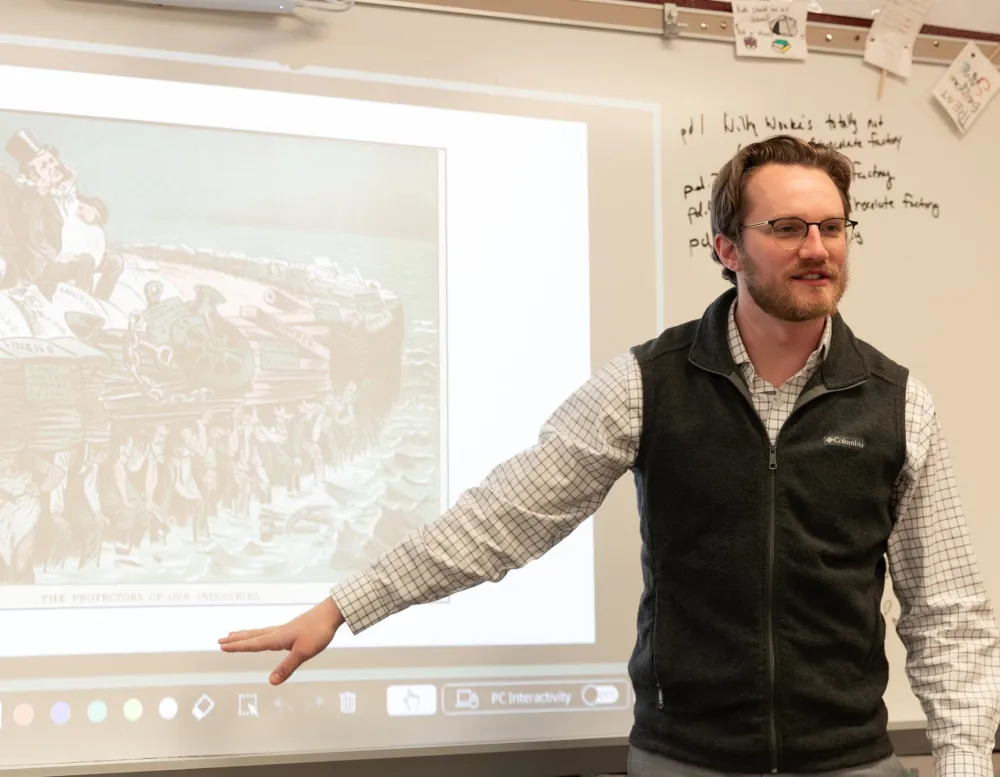
Innovate and lead in education with our Master of Education in Educational Design and Inquiry.
This program integrates equity in education, design thinking, and teacher inquiry to prepare educators for transformative leadership and impact in classrooms and beyond.
Majors & Minors
| Program Name | Program Type |
|---|---|
Educational Inquiry |
Graduate Degree |
Why study Educational Design and Inquiry?
Gettysburg College’s M.Ed. in Educational Design & Inquiry is built for practicing K–12 teachers who see classroom challenges not as barriers, but as invitations to rethink, redesign, and innovate – alongside a live cohort of fellow educators, grounded in the work you do every day. The program is fully online, with live synchronous sessions and no travel required.
What it means for your classroom
- Redesign lessons, assessments, and classroom culture around what students actually need
- Test practical, evidence–informed strategies in real time
- Turn persistent challenges into problems of practice worth exploring
- Build more inclusive and engaging learning environments
What it means for your career
- Grow as a teacher–leader without leaving the classroom
- Build habits of inquiry, reflection, and design that strengthen long–term practice
- Earn a master’s that signals initiative, creativity, and applied problem–solving
- Prepare for future leadership, mentorship, curriculum, or instructional roles
Why study Educational Design and Inquiry at Gettysburg
Opportunities
Online doesn’t have to mean alone.
You move through the program with the same small cohort of roughly ten working teachers – fellow disruptors – building a close–knit professional community over time. Live, synchronous sessions create space for real dialogue, shared problem–solving, and mentorship – the flexibility of online learning with the energy of a true cohort experience. No travel required.
How the online format works
- Fully online – you learn live and in real time with your cohort and instructors, not in self–paced isolation
- Live synchronous sessions are paired with independent work you complete on your own schedule between sessions
- Predictable pacing built around the school year: one course each fall, one each spring, and two over the summer
- About 3–5 hours per week during the school year; 15–20 hours per week in summer
- Synchronous sessions designed for discussion, reflection, and collaborative problem–solving

Academics
Every course is grounded in your own classroom. You design, test, and refine ideas with your actual students – turning coursework into immediate, tangible improvements in your practice. What you explore one week can shape what you do with students the next.
The program blends three powerful, practice–oriented approaches: Design Thinking, Teacher Inquiry, and Equity in Education – a focused M.Ed. experience, not a generic education degree. You’ll learn to empathize deeply, reframe problems, and ideate bold solutions, becoming an adaptive, reflective practitioner.
Coursework you can use Monday morning
You’ll explore the challenges that matter most in today’s classrooms:
- Design Thinking in the Curriculum – Move through the full design process to transform your curriculum, with an orientation to Gettysburg’s Innovation & Creativity Lab.
- Reflective Inquiry – Turn everyday classroom experiences into evidence–based improvements to your practice.
- Classroom Climate & Culture – Build trust, respect, and belonging – and use conflict to strengthen, not fracture, your classroom.
- Cognitive Science & Learning – Translate how students actually think, remember, and learn into practical strategies.
- Equity in Education – Examine systems of privilege and power and design fair, inclusive, empowering classrooms.
- Place–Based, Reimagining Education & Action Research – Connect learning to community, challenge the status quo, and run real action research – culminating in a capstone applied to a real problem of practice.

Community of Experts and Professors
You’ll partner closely with faculty who know you and challenge you – including practicing K–12 teachers recognized for their leadership and innovation, and school leaders who understand the realities of your classroom. They’re mentors and collaborators, not distant lecturers.
Still deciding? Before you apply, sit down with one of them. Ask about the workload, the cohort, tuition reimbursement, or whether the program fits your classroom – no pressure, no admissions pitch.

Built Around a Teaching Life
For many working teachers, the biggest barriers are time, cost, and confidence that a program will actually fit their lives. This M.Ed. is designed to make graduate study manageable while still offering the rigor, connection, and applied learning you expect from a meaningful master’s.
Cost, payment & reimbursement
- $850 per credit – $2,550 per 3–credit course
- A deferred–payment option supports educators using employer tuition reimbursement
- No travel costs – the program is fully online
Using employer tuition reimbursement? A deferred–payment option can help – see how deferred payment works.
At Gettysburg College, we are committed to preparing students to rise to the unfinished work of our time. Our new Master of Education program will ready K-12 teachers from across the nation to answer this call by both fostering innovation and advancing access in education.
“Hearing from others made me think about the issues I’m dealing with in a different light – and take different approaches to issues that arise in my own classes.”
— Current M.Ed. cohort member
At Gettysburg College, we are committed to preparing students to rise to the unfinished work of our time. Our new Master of Education program will ready K–12 teachers from across the nation to answer this call by both fostering innovation and advancing access in education. This is a program for educators ready to think boldly, creatively, and substantively about the challenges they face—transforming insight into action within their own classrooms. Through real-time collaboration and dynamic synchronous learning, educators develop a strong professional network that supports meaningful growth and shared problem-solving.
Innovative and Intentional Learning

Design Kits for Real-Time Collaboration
Our students don’t just talk about innovation—they build it. Throughout the program, educators receive custom at-home design kits that allow them to prototype, test ideas, and collaborate with peers in real time, even from different locations. These hands-on sessions bring design thinking to life and model powerful approaches that teachers can use with their own students.

Personalized Reflection Journals
Every educator receives a personalized journal laser-engraved in Gettysburg’s own Innovation & Creativity Lab. Used throughout all courses, the journal becomes a space for deep reflection, design documentation, and the story of a teacher’s growth across the program. It represents our belief that transformation takes time, intention, and meaningful self-reflection.
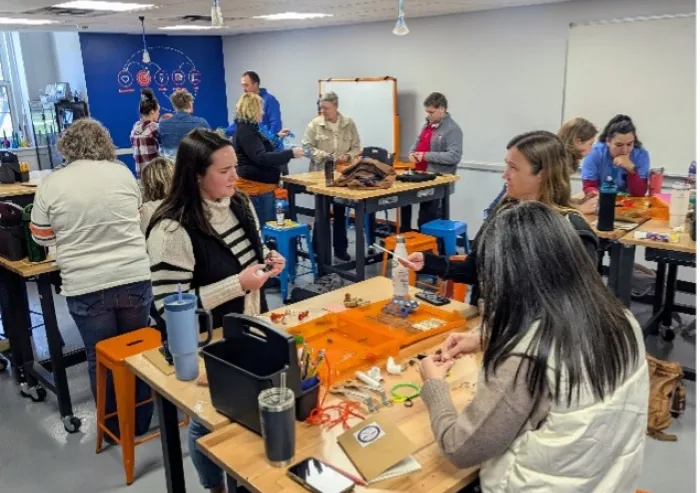
24/7 Access to the Innovation & Creativity Lab
M.Ed. students have full access to the on-campus Innovation & Creativity Lab—a collaborative makerspace equipped for prototyping, digital fabrication, and creative experimentation. Whether you’re designing instructional materials, building models, or testing ideas with peers, the lab provides a home for imagination, creation, and professional connection.
Where to find us
Upcoming Education Conferences:
| Event | Date | Website |
|---|---|---|
| Pennsylvania Educational Technology Expo & Conference 2026 | February 1–4, 2026 | https://www.peteandc.org/aboutus.cfm |
| Conference on Higher Education Pedagogy 2026 | February 4–6, 2026 | https://chep.teaching.vt.edu/ |
| Pennsylvania Association of Middle Level Education | February 21-23, 2026 | https://www.pamle.org |
| Pennsylvania Association of Environmental Educators | March 8-10, 2026 | https://www.paee.net/conference/ |
| Maryland Common Ground Conference | March 19-20, 2026 | https://web.cvent.com/event/190cedc2-af91-4861-96f6-71655afd0738/summary |
| Keystone Technology Innovators STAR Summit 2026 | July 27–31, 2026 | https://www.paect.org/kti/summit |
Featured Courses
600 Level
This course explores the principles and practices of design thinking and their application within educational settings. Students will learn how to integrate design thinking into the curriculum to foster creativity, problem-solving, and innovation among students. The course emphasizes a hands-on, experiential approach, where participants will engage in collaborative projects that model the design thinking process, including empathizing with learners, defining challenges, ideating solutions, prototyping, and testing. *This course will include an ICL orientation so that candidates have the skills that are necessary for success in the program. These sessions will be co-taught with ICL staff. **Lab fee
This course examines the development of a positive, inclusive classroom culture through the implementation of restorative practices. "Classroom Climate & Culture" focuses on building strong, respectful relationships among students and between students and educators, fostering a community-centered approach to classroom management and conflict resolution.
This course offers an interdisciplinary exploration of Cognitive Science, the study of the mind and its processes, drawing from psychology, neuroscience, linguistics, philosophy, artificial intelligence, and anthropology. Students will investigate how humans perceive, think, learn, and remember, as well as how these cognitive processes are influenced by biological, social, and technological factors.
Educational Design and Inquiry Curriculum News


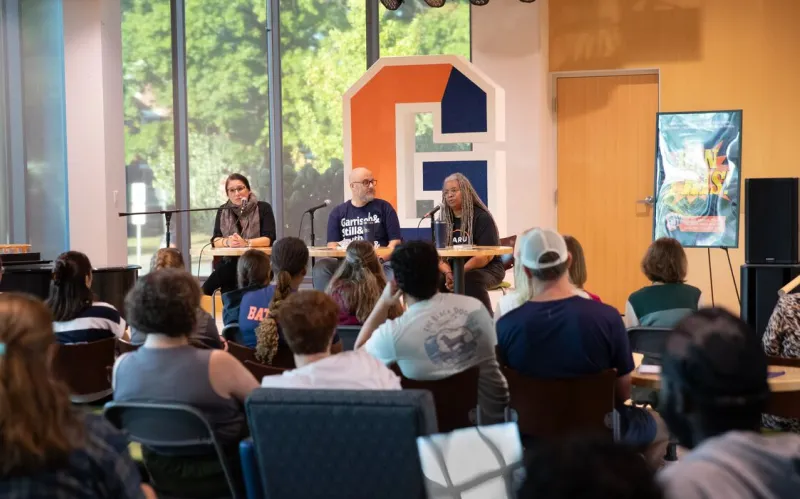

The M.Ed. in Educational Design and Inquiry provides a thoughtfully designed curriculum centered on Equity in Education, Design Thinking, and Teacher Inquiry.
Through a cohort-based model, students engage in collaborative learning experiences that foster deep connections with peers and faculty mentors. Courses blend theory with hands-on practice, equipping educators with the skills to design inclusive, innovative learning environments.
Curriculum
The M.Ed. in Educational Design and Inquiry offers a cohesive and practice-centered curriculum grounded in the principles of Design Thinking, Teacher Inquiry, and Equity in Education. Courses such as Design Thinking in Education, Equity in Education, Classroom Climate and Culture, and Place-Based Learning invite educators to reimagine teaching through innovative, inclusive, and evidence-based approaches. A culminating capstone project anchors the program, allowing students to design and implement new pedagogical initiatives or address pressing educational challenges in their own classrooms. Throughout their studies, participants apply theory to practice—developing original instructional strategies and materials that lead to meaningful, lasting change in their schools and communities.
Program Format
This two-year program is designed for the realities of full-time educators. Students complete ten total courses—one each during the fall and spring terms (14 weeks each), and one during each of two intensive summer sessions (5 weeks each). This schedule allows teachers to maintain balance during the school year while still reserving several weeks each summer for rest and renewal. All coursework is completed within a close-knit cohort of 8–10 K–12 educators, fostering sustained collaboration and professional growth. The fully online format offers flexibility alongside rich, synchronous engagement, with optional in-person opportunities available through Gettysburg’s Innovation and Creativity Lab. For a detailed view of term dates and pacing, see the M.Ed. Program Calendar.
Courses
| Course Number | Course Title | Course Description |
|---|---|---|
| MEDU 600 | Design Thinking in the Curriculum | This course explores the principles and practices of design thinking and their application within educational settings. Students will learn how to integrate design thinking into the curriculum to foster creativity, problem solving, and innovation among students. The course emphasizes a hands-on, experiential approach, where participants will engage in collaborative projects that model the design thinking process, including empathizing with learners, defining challenges, ideating solutions, prototyping, and testing. *This course will include an ICL orientation so that candidates have the skills that are necessary for success in the program. **Possible minimal lab fee |
| MEDU 610 | Reflective Inquiry | This course delves into the practice of reflective inquiry as a critical tool for educators to examine and enhance their teaching practices. Reflective inquiry involves the systematic exploration of one’s own teaching experiences, beliefs, and outcomes to gain deeper insights into effective pedagogy and student learning. *This course will include information literacy skills that are necessary for success in the program. |
| MEDU 620 | Classroom Climate & Culture | This course examines the development of a positive, inclusive classroom culture through the implementation of restorative practices. "Classroom Climate & Culture" focuses on building strong, respectful relationships among students and between students and educators, fostering a community-centered approach to classroom management and conflict resolution. |
| MEDU 630 | Cognitive Science & Learning | This course offers an interdisciplinary exploration of Cognitive Science, the study of the mind and its processes, drawing from psychology, neuroscience, linguistics, philosophy, artificial intelligence, and anthropology. Students will investigate how humans perceive, think, learn, and remember, as well as how these cognitive processes are influenced by biological, social, and technological factors. |
| MEDU 640 | Equity in Education | This course examines the principles and practices of equity in education, focusing on strategies to create inclusive, fair, and supportive learning environments for all students. "Equity in Education" addresses the systemic inequalities that affect students’ access to and success in educational settings, and explores ways to dismantle barriers related to race, ethnicity, gender, socioeconomic status, disability, and other factors. |
| MEDU 650 | Place-Based Education | This course explores the principles and practices of place-based education, an approach that connects learning to the local environment and community. Place-based education leverages the unique cultural, historical, and ecological resources of a specific place to create meaningful, relevant learning experiences for students. The course emphasizes experiential, hands-on learning that fosters a deeper connection to the local community and environment, while also promoting academic achievement and social responsibility. **Possible minimal lab fee |
| MEDU 660 | Reimagining Education | This course challenges traditional educational paradigms and explores innovative approaches to teaching and learning in the 21st century. "Reimagining Education" invites educators, administrators, and policymakers to critically examine the current education system and envision transformative changes that can better meet the needs of diverse learners in a rapidly evolving world. **Possible minimal lab fee. |
| MEDU 670 | Action Research | Building on the foundational knowledge and skills acquired in previous courses, "Action Research" offers an in-depth exploration of research methodologies that empower educators to systematically investigate and improve their own practices. This course focuses on the design and implementation of action research projects aimed at addressing specific challenges or opportunities within educational settings. *Must be taken before Capstone I or II. |
| MEDU 680 | Capstone I | In Capstone Project I, students will begin the process of developing a comprehensive research or practical project that synthesizes and applies the knowledge and skills gained throughout their program. This first part focuses on defining the project scope, creating a detailed proposal, and designing the research or implementation plan. **Possible minimal lab fee |
| MEDU 690 | Capstone II | Capstone Project II builds on the work completed in Capstone Project I, focusing on the execution, analysis, and reflection of the capstone project. This second part involves carrying out the research or practical activities as outlined in the proposal, analyzing results, and reflecting on the project’s impact. **Possible minimal lab fee |
Admissions Policies and Deadlines
Applicant Eligibility
Eligible applicants must have a bachelor’s degree to be considered for admission to the program.
Graduate Application for Admission.
The program application requires that applicants submit:
- Transcripts from all post-secondary degree-granting institutions attended. Unofficial transcripts may be submitted for admission, but all admitted students must submit official documents by the end of the first semester
- Letter of Intent
- Resume listing all completed education, degrees conferred, and current and past work experience
Applicants who have not completed a degree at an institution where English was the primary language of instruction must submit English-proficiency test scores.
Conditional Admission and Matriculation
Students submitting unofficial transcripts are conditionally admitted, and official transcripts must be received by the end of the first course. Holds will be placed on the student’s account without official transcripts, affecting registration and transcript issuance.
Terms and Deadlines
Students may apply for admissions in the following terms: Summer I or Fall. Applications for Summer I are due April 10th. Applications for Fall are due July 17th.
Payment Options
Standard Payment
Payment for each course is due one week prior to the start of the academic term. Details for payment submission will provided upon acceptance into the program.
Deferred Payment
To make graduate study more accessible for working educators, Gettysburg College offers a deferred payment option for teachers who receive tuition reimbursement from their districts. This option allows eligible students to defer payment until after each course is completed and final grades are issued, avoiding the need to pay tuition upfront. To qualify, teachers simply submit a verification letter from their employer confirming eligibility for tuition reimbursement benefits.
Educational Design and Inquiry
More In Educational Design and Inquiry
Ready to Do Great Work?
