
Physics

Discover the “nature of things” with a Physics major or minor
Perfect for curious tinkerers, physics explores the secrets and fundamental laws of the universe, the mysterious nature of matter and energy, the powerful forces by which objects interact, and the sometimes-strange behavior of objects at the smallest scales. From subatomic particles to the entire observable universe, the problem-solving skills developed in our physics program lay the foundation for students to tackle technological challenges and progress human knowledge.
Majors & Minors
| Program Name | Program Type |
|---|---|
Physics |
Major Bachelor of Arts |
Physics |
Major Bachelor of Science |
Engineering |
Major Dual Degree |
Physics |
Minor |
Why study Physics?
From analyzing large swaths of data for a government agency, creating processes to streamline production, or educating others on how to solve difficult problems, society needs individuals who are willing to solve complex problems through logical reasoning. To meet this need, Gettysburg College offers a minor in physics, a B.A. in physics, a B.S. in physics, and a dual degree in engineering. Each component of the bachelor’s in physics degree program prepares you to branch out into the diverse sectors of business, education, engineering, government, research, or technology.
Why study Physics at Gettysburg
Opportunities
You’ll learn in small classes that emphasize collaboration and hands-on experimentation, from studying the motion of everyday objects to probing the mysteries of the cosmos in the campus planetarium or observatory. The integration of an interdisciplinary education encourages physics majors to actively engage with their peers and the world around them to solve problems.

Academics
Our physics curriculum emphasizes hands-on learning and is designed to ensure you are given a solid foundation for entry into the workforce or graduate study.
Both the Bachelor of Arts and the Bachelor of Science in physics degree programs aim to hone students’ problem-solving skills through a diverse range of courses, electives, and labs. As a physics major, you develop your understanding of the basic principles of physics through computational techniques, laboratory competence, mathematical modeling, and oral and written communication.

Community of Experts and Professors
Earning a Physics degree at Gettysburg College is an immersive and supportive experience where students are encouraged to explore, question, and discover alongside dedicated faculty mentors. Here you'll find a close-knit community where students often work together on research projects, share discoveries in labs, and participate in campus-wide science events.

Earning a Physics degree at Gettysburg College is an immersive and supportive experience where students are encouraged to explore, question, and discover alongside dedicated faculty mentors.
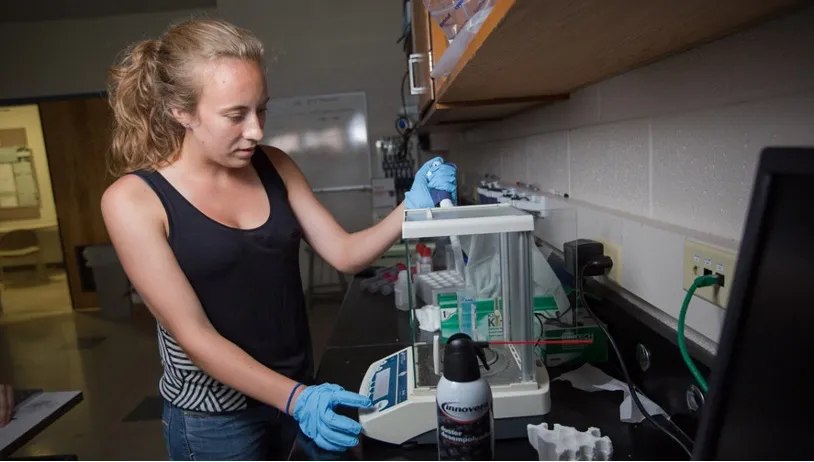
You’ll learn in small classes that emphasize collaboration and hands-on experimentation, from studying the motion of everyday objects to probing the mysteries of the cosmos in the campus planetarium or observatory. Here you'll find a close-knit community where students often work together on research projects, share discoveries in labs, and participate in campus-wide science events.
What is it like studying physics at Gettysburg College?
You’ll have a unique opportunity to work with cutting edge equipment while receiving one-to-one support of our dedicated faculty. In advanced labs, students are replicating Nobel Prize winning experiments, building experimental setups from scratch, developing computational skills using programming language, and working with their hands to develop vital skills coveted by employers. In theory courses, students are challenged to relate highly esoteric concepts to the world around them while building meaningful friendships within our welcoming community of physics students. Most of our students participate in at least one research project before their senior year, either with a member of the faculty or off campus at a national laboratory.
Interested in engineering?
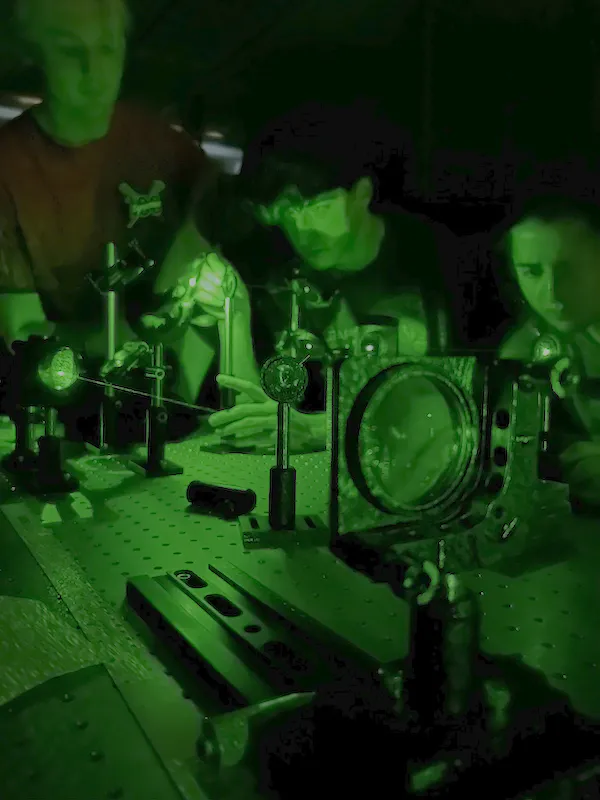
We offer the Dual Degree Program for students to study physics at Gettysburg College for 3 years and then transfer to an engineering program (e.g., Columbia University) for another 2 years. After 5 years, you’ll receive two degrees: a physics degree and an engineering degree. This is a very popular program!
Career options with a physics degree?
Our students pursue diverse careers in medicine, government, business, law, engineering, and physics research. The Bachelor of Science (B.S.) degree is great for students who want to pursue further education or careers in science. The Bachelor of Arts (B.A.) degree is perfect for those wanting to pursue multiple majors at Gettysburg College (e.g., music and physics) or a Physics Concentration. The physics minor is useful for those looking to compliment or enhance another major (e.g., Chemistry major with Physics minor) in preparation for a more advanced program such as medical school.
Gettysburg’s physics majors have gone on to work in fields such as astronomy, astrophysics, business, education, engineering, law, mathematics, meteorology, physics, and psychology. Whether you seek a B.A. or B.S in physics, you’ll have ample career options to choose from.
Like working with your hands?
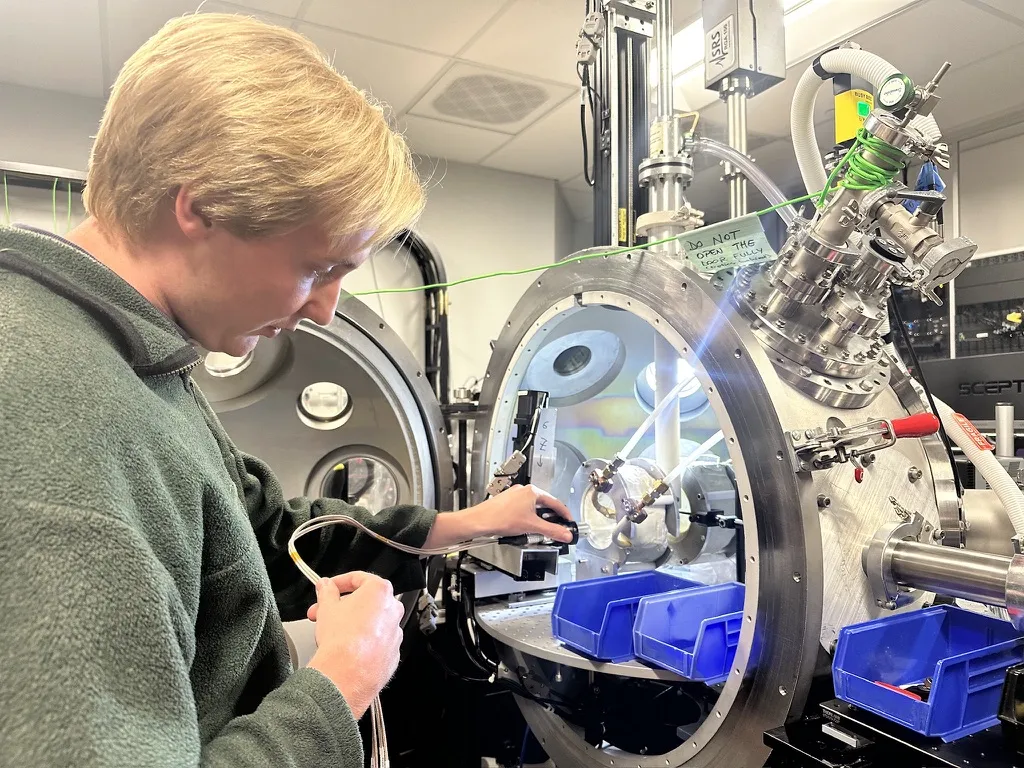
Take one of our advanced labs. We offer an electronics course (that fills up fast!) where students learn to solder, design circuits, and creatively develop their own projects. We also offer a quantum optics course to study, for instance, single photon events! Take a look at more courses.
Strong Gettysburg alumni network
All physics students have access to the Gettysburg Network via the connectGettysburg platform. Serving as the College’s online engagement, networking, and mentoring platform, connectGettysburg offers endless connections for networking with Gettysburg’s more than 32,000 alumni.
Featured Courses
Visit Curriculum tab for a comprehensive list of all available courses
200 Level
An introduction to classical electromagnetic theory and applications: electrostatic fields, currents, magnetic fields, magnetic induction, and Maxwell's equations. Other topics include electric circuits, waves, light as a propagating electromagnetic disturbance, and radiating charge. Prerequisites: Physics 112 and Mathematics 112, which may be taken concurrently; or permission of instructor. Four class hours and three laboratory hours.
300 Level
Combined upper-level chemistry and physics lab designed to emphasize the use of tools in these disciplines to answer questions in biology. This course concentrates on the role of lipids (fats) and ions (salt) in biology. Utilizing multiple biochemical and biophysical techniques, students will perform multiple experiments to ultimately answer a complex biological problem. Two laboratories. Spring semester. Prerequisite: CHEM 108 and either PHY 110 or PHY 211, or permission from the instructor.
Experimental investigation of quantum phenomena. A suite of single photon measurements will explore the statistical nature of quantum physics. Other experiments include alpha-, beta-, and gamma-spectroscopy, x-ray diffraction, and UV-fluorescence. The course emphasizes error analysis and communicating scientific results through oral and written reports. Prerequisites: Physics 310. Six laboratory hours.
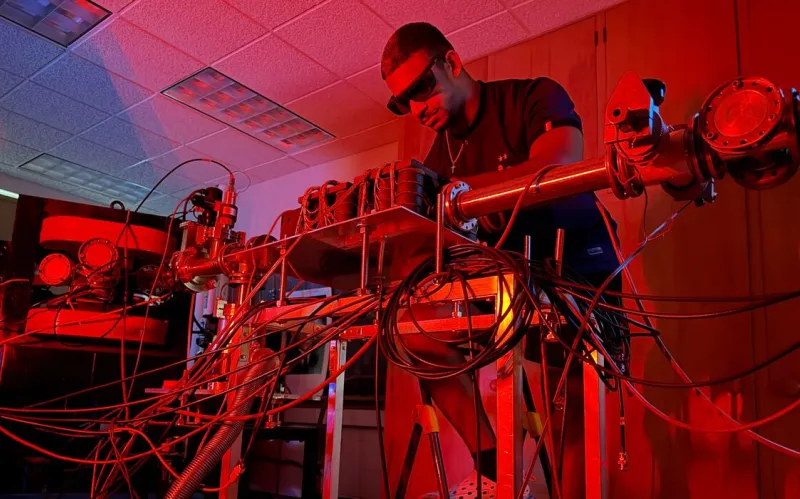

Our curriculum prepares students for success in a range of careers and graduate study. Our courses build a strong foundation in problem solving, important physical principles, and the application of math to real-world situations.
Laboratory training stresses the design of experiments, the techniques of precise measurement, the interpretation of data, and written and oral communication. In advanced classes, you’ll apply your skills through independent study and research projects in collaboration with our involved faculty, who often form mentorship relationships with students.
Students also have the opportunity to combine their physics studies with other scientific pursuits through physics concentrations. Students learn by doing through research as part of the Cross-Disciplinary Science Institute and our capstone course. Our Engineering Dual-Degree program combines the enhanced communication skills and creativity of a liberal arts education with the focused rigor of a highly regarded engineering program.
Major and Minor Information
We offer both a Bachelor of Science and Bachelor of Arts degree for the Physics major. These flexible programs are well suited for a variety of careers. We graduate about 10-15 majors per year. Between a third to a half of our graduates enter PhD programs in physics and astronomy or MS programs in engineering. Most of the rest go directly into industry, mostly working in technical fields using their problem-solving skills developed in the physics department.
Gettysburg College physics majors have succeeded in diverse careers, including government, law, management, engineering, teaching, nuclear physics, plasma physics, astronomy research, data and computer analytics, consulting, and medicine. You’ll also be well prepared for graduate study in fields including astronomy, all the subfields of physics from nuclear to condensed matter to biophysics to astrophysics, business, geophysics; and environmental, electrical, nuclear, and mechanical physics and engineering.
Whatever career you pursue in the future, a background in physics will provide you with the foundational and technological skills needed to excel in the 21st century.
A minimum of ten courses are required for the Physics major, Bachelor of Arts.
Introductory Physics Courses
- Take either the combination of PHY 111, 112, and 211 or PHY 109 and 110
Physics Core Courses
- PHY 255
- PHY 310
- One advanced lab course from the following: PHY 240, 324, 350, 352, 358, or approved course
- PHY 420a or PHY 420b (or PHY 460 with approval of department)
Physics Electives
- 1 course from PHY 312, 319, 330, or 341. CHEM 305 may substitute for PHY but not count in addition to PHY 312 in the Physics major
- 2 physics courses at the 200-level or higher, which may include CHEM 306
- If PHY 109 and 110 were taken for the introductory requirement, then one additional physics 200-level elective course is required.
Mathematics Requirement
- Calculus Math courses through Math 211
A minimum of fourteen courses are required for the Physics major, Bachelor of Science.
Introductory Physics Courses
- Take either the combination of PHY 111, 112, and 211 or PHY 109 and 110
Physics Core Courses
- PHY 255
- PHY 310
- One advanced lab course from the following: PHY 240, 324, 350, 352, 358, or approved course
- PHY 420a or PHY 420b (or PHY 460 with approval of department)
Physics 300-level Courses
- 3 courses from PHY 312, 319, 330, or 341. CHEM 305 may substitute for PHY but not count in addition to PHY 312 in the Physics major.
Physics Electives
- 2 physics courses at the 200-level or higher, which may include CHEM 306
- If PHY 109 and 110 were taken for the introductory requirement, then one additional physics 200-level elective course is required.
Mathematics Requirement
- Calculus Math courses through Math 211
- Math 225
Gettysburg College's engineering dual-degree program combines the enhanced communication skills and creativity of a liberal arts education with the focused rigor of a highly regarded engineering program.
Gettysburg College offers dual-degree engineering programs in conjunction with Columbia University in New York City, Rensselaer Polytechnic Institute in Troy, New York, Washington University in St. Louis, Missouri, and the University of Pittsburgh in Pittsburgh, Pennsylvania.
| Partner Institution | Curriculum Guide |
|---|---|
| Washington University at St. Louis | Pre-Combined Plan Curriculum Guide (PDF) |
| Columbia University | Pre-Combined Plan Curriculum Guide (PDF) |
| Rensselaer Polytechnic Institute | Pre-Dual-Degree Curriculum Guide (PDF) |
| University of Pittsburgh | Pre-Dual-Degree Curriculum Guide (PDF) |
Upon successful completion of the program, the student is awarded the bachelor–of-arts degree from Gettysburg and the bachelor-of-science degree in an engineering discipline from one of the four affiliated universities. Since the student graduates with two degrees, all degree requirements from both institutions must be completed, including a major at each institution. The Gettysburg College major can be in any discipline provided the student completes the pre-engineering courses and the Gettysburg College curricular requirements before starting at the engineering school. The affiliation agreement between schools allows many courses to transfer so that the student can complete both degrees in 5 years. American students who qualify for financial aid at Gettysburg College will usually be eligible for similar aid at the engineering affiliate universities. International students who qualify for aid at Gettysburg are not guaranteed financial aid, although it is sometimes available.
In addition to their college advisor, candidates for this program are advised by the Engineering Advisor who is a member of the physics department. Normally, a student will be recommended to Columbia, RPI, Washington University, or Pitt during the fall semester of the junior year. Under the typical "3-2" option, students spend three years at Gettysburg and two at the partner institution.
The grade requirements for guaranteed admission are different for each program, but at a minimum students need a 3.0 GPA to be recommended. However, admission to Columbia University will no longer be guaranteed for the students enrolling in Fall 2019 and thereafter. The specific courses required for admission by each affiliated institution vary and students should schedule courses in close cooperation with the Engineering Adviser at Gettysburg.
All dual-degree engineering students must take Physics 111, 112, 211 or Physics 109, 110 (depending on engineering field this is likely the preferred option for non-physics majors); Mathematics 111, 112, 211, (plus 212 and 225 for many engineering fields); Chemistry 107; and Computer Science 107 or 111 (depends on engineering field). Students interested in Columbia University should also take Economics 103 or 104. All dual-degree engineering students must complete the Gettysburg College curricular requirements while at Gettysburg. We recommend that 3-2 students begin working on their Gettysburg College major their first year.
While the 3-2 option is considered typical, our affiliate schools also allow the 4-2 option, whereby students complete four years at Gettysburg before transferring. In both cases the student receives two bachelor degrees at the end of the program. For financial aid reasons it is strongly recommended that students delay their Gettysburg College graduation until the end of their work at the engineering school (the 5th or 6th year depending whether 3-2 or 4-2). Both 3-2 and 4-2 students are allowed to march at the Gettysburg College graduation with their graduating class even if they are not graduating provided certain criteria are met.
Some students choose to transition to engineering by finishing 4 years at Gettysburg College and then applying to graduate schools in engineering. In this case students can apply to a broad range of schools, though some of our affiliate schools have special programs our students can consider. The graduate school option changes the financial aid picture as the student would no longer be an undergraduate. In addition, skipping the undergraduate degree in engineering usually prevents the student from sitting for professional licensure exams.
Six courses in Physics required for the minor. Choose either of the following combinations of six courses.
Courses Starting with PHY 109
- PHY 109
- PHY 110
- Four additional physics courses at the 200-level or above, which may include one of the following non-physics courses: CHEM 305, 306, 307, MATH 325, 361, 363, or 364.
Or Courses Starting with PHY 111
- PHY 111
- PHY 112
- PHY 211
- Three additional physics courses at the 200-level or above, which may include one of the following non-physics courses: CHEM 305, 306, 307, MATH 325, 361, 363, or 364.
Notes:
- No more than two 100-level courses may be used to fulfill minor requirements.
- Courses taken under the S/U grading option do not count toward the minor.
Mathematical Physics
Math and Physics tend to go hand-in-hand. Given the math requirements for our physics major, many physics majors opt to get a minor in math. Pursuing the BS track in physics with a math minor or double major is excellent preparation for physics, astronomy, or engineering graduate school and is recommended for students interested in theoretical physics.
| Program Component | Details |
|---|---|
| Physics Major (BA or BS) | Suggested electives (best to take all): Phy312: Thermodynamics and Statistical Physics Phy319: Classical Mechanics Phy330: Electricity and Magnetism Phy341: Quantum Physics |
| Math Minor | Suggested electives: Math212: Linear Algebra Math225: Differential Equations Math302: Applied Research in Mathematics Math325: Partial Differential Equations Math364: Complex Analysis |
Physics and Data Science
More and more science disciplines use big data, from astronomical sky surveys to molecular simulations of materials such as liquid crystals or DNA. Adding a Data Science Minor to a physics major builds proficiency with large data sets alongside deep knowledge of physical processes relevant across STEM fields.
| Program Component | Details |
|---|---|
| Physics Major (BA) | Suggested electives: Phy240: Analog and Digital Electronics (upper-level lab) Or Phy350: Observational Astronomy (upper-level lab) Phy335: Computational Physics |
| Data Science Minor | Suggested electives: Phy335: Computational Physics Phy350: Observational Astronomy |
Computational Physics
Computational modeling now plays a central role in physics research—from Monte Carlo simulations in particle physics to molecular dynamics in condensed matter and biophysics. Strong coding and computational skills open doors across modern physics.
| Program Component | Details |
|---|---|
| Physics Major (BA) | Suggested electives: Phy240: Analog and Digital Electronics (upper-level lab) Or Phy350: Observational Astronomy (upper-level lab) Phy335: Computational Physics |
| Computer Science Minor or Major | Computer Science Minor or Computer Science Major (BS degree) |
Entrepreneurial Physics
In an increasingly technological world, businesses must adapt quickly and anticipate scientific breakthroughs. Physics develops analytic agility and problem-solving skills; pairing it with business training allows students to translate scientific insight into innovation.
| Program Component | Details |
|---|---|
| Physics Major (BA) | Suggested skill-focused electives: Phy240: Analog and Digital Electronics (upper-level lab) Or Phy352: Optics and Laser Physics (upper-level lab) Phy335: Computational Physics |
| Business Minor | Business Minor |
Physics and Philosophy
Students gain fluency in both Physics and Philosophy, approaching fundamental questions about life and existence through scientific and humanistic lenses.
| Program Component | Details |
|---|---|
| Physics Major (BA) | Suggested electives: PHYS324: Experiments in Quantum Mechanics (upper-level lab) PHYS341: Quantum Physics |
| Philosophy Minor | Suggested electives: PHIL233: Philosophy of Science PHIL312: History and Philosophy of Quantum Mechanics PHIL315: The Nature of Space: Philosophical Revolutions in Physics |
Physics of Materials
Develop a strong grasp of physical principles central to condensed matter and materials science. Students gain experience with instrumentation, techniques, and core concepts shaping materials research.
| Program Component | Details |
|---|---|
| Physics Major (BA or BS) | Suggested electives: Phy240: Analog and Digital Electronics (upper-level lab) Phy341: Quantum Physics Phy312: Thermodynamics and Statistical Physics or Chem305: Physical Chemistry I: Chemical Thermodynamics and Kinetics |
| Chemistry Minor | Suggested electives: Chem222: Chemistry: Contemporary Issues and Practices Chem306: Physical Chemistry II: Quantum Chemistry and Spectroscopy Chem320: Materials Chemistry |
First Year Advising and Registration recommendations
Students planning to major in Physics should take PHY 111 and MATH 111 followed by PHY 112 and MATH 112 (or a higher-level math sequence) in their first year.
All dual-degree engineering students must take Physics 111, 112, 211 or Physics 109, 110 (depending on engineering field this is likely the preferred option for non-physics majors); Mathematics 111, 112, 211, (plus 212 and 225 for many engineering fields); Chemistry 107; and Computer Science 107 or 111 (depends on engineering field).
Students interested in the Dual-Degree Engineering Program should attend the dual-degree advising session and make an appointment to discuss their plans with Dr. Yoshihiro Sato (ysato@gettysburg.edu), the dual-degree advisor. There are fifteen engineering majors that students can pursue across our four affiliate programs, so prospective dual-degree students are highly encouraged to make an appointment with Dr. Sato and their academic advisor to ensure they are enrolled in the correct sequence of courses that will transfer to their intended engineering major. As with all students, prospective dual-degree students must enroll in a First Year Seminar, complete the first-year writing requirement, pursue a major at Gettysburg College, and complete a second language along with the other general Gettysburg College curricular requirements.
Available Courses
100 Level
General algebra-based coverage of the fields of classical and modern physics. Topics include kinematics, mechanics, fluids, and thermodynamics. Does not count toward the physics major; appropriate course for students in biology, environmental science, the health professions. Prerequisite: Sophomore status and facility with algebra and geometry. Three class hours and three laboratory hours.
General algebra-based coverage of the fields of classical and modern physics. Topics include waves, optics, electricity, magnetism, and topics from modern physics. Does not count toward the physics major; appropriate course for students in biology, environmental science, the health professions. Prerequisite: Physics 103 and facility with algebra and geometry. Three class hours and three laboratory hours
An introduction to the physical basis of music and sound production. Topics include the mechanical and sonic characteristics of common musical instruments, room acoustics, human perception of sound, and the mechanics of the human ear. Special emphasis is placed on how fundamental concepts from math and physics (vibrations and waves, logarithmic measurement scales, the Fourier Series, frequency spectra) explain many of the aspects of how music is produced and perceived. Does not count toward the physics major; appropriate course for non-science majors. Three class hours and three laboratory hours.
Standard first semester calculus-based Physics course designed to support the curricula of Chemistry and Biochemistry & Molecular Biology majors. The course will explore a wide range of topics including Newtonian mechanics, work & energy, circular motion, rotational kinematics/dynamics, fluids, concepts of heat & temperature, kinetic theory, and thermodynamics. Prerequisite: Calculus 111 (can be taken concurrently), sophomore or higher status, and CHEM or BMB Major. Three class hours and three laboratory hours.
Standard second semester calculus-based Physics course designed to satisfy the major requirements for Chemistry, and Biochemistry and Molecular Biology majors but can be taken by other students that meet the requirements. The course will explore a wide range of topics including vibrations and sound, light, optics, electricity and magnetism, and electric circuits. Prerequisite: Physics 109. Three class hours and three laboratory hours.
An introduction to mechanics and modern physics: the conservation of momentum, energy, and angular momentum as fundamental laws, Newton’s dynamical laws of motion, and the special theory of relativity. Four class hours and three laboratory hours. Prospective physics majors or students interested in dual-degree engineering. Open to first-year students; sophomore students interested in the physics major may enroll with permission of instructor.
An introduction to modern physics and thermodynamics: Continuation of the special theory of relativity; introductory principles of quantum physics; applications in atomic, nuclear, and particle physics; and an introduction to thermodynamics. Differential and integral calculus is introduced and used. Prerequisites: Physics 111 and Math 111, which may be taken concurrently, or permission of instructor. Four class hours and three laboratory hours. Prospective physics majors or students interested in dual-degree engineering. Open to first-year students; sophomore students interested in the physics major may enroll with permission of instructor.
Overview of the fundamental principles of classical physics (including gravitation and electromagnetism), the theory of relativity, and quantum physics. Course includes topics such as: the four fundamental forces of nature; nuclear and atomic physics; elementary particles; grand unified theories; and cosmology, including the origin and fate of the universe. Does not count toward the physics major; appropriate course for non-science majors. Three class hours and three laboratory hours.
200 Level
Principles of electronic devices and circuits using integrated circuits, both analog and digital, including amplifiers, oscillators, and logic circuits. Prerequisites: Physics 211, Physics 110 or permission of instructor. Three class hours and three laboratory hours.
Quarter credit internship graded S/U.
Intermediate treatment of mathematical methods used in physics. Topics include elements of vector calculus, complex variables, ordinary and partial differential equations, solution of Laplace's equation, special functions, determinants, and matrices. Prerequisites: Physics 211 and Math 112. Three class hours.
The course is designed to provide a basic familiarity with the most common techniques used in structural biology and their applications to challenging biochemical, biotechnology and medical problems. Course focuses on current state-of-the-art biophysical methods that are being applied to study structure and function of biological macromolecules and biological systems with a focus on the most informative methods, such as X-ray crystallography, NMR spectroscopy, and single molecule techniques. Theoretical underpinnings and the practical applications are covered. Three class hours. Spring semester. Prerequisite: CHEM 108, or either PHYS 110 or PHYS 211, or permission from the instructor
An introduction to classical electromagnetic theory and applications: electrostatic fields, currents, magnetic fields, magnetic induction, and Maxwell's equations. Other topics include electric circuits, waves, light as a propagating electromagnetic disturbance, and radiating charge. Prerequisites: Physics 112 and Mathematics 112, which may be taken concurrently; or permission of instructor. Four class hours and three laboratory hours.
300 Level
Intermediate course in electromagnetism, including vector fields and vector calculus, electrostatic field theory, dielectrics, magnetic phenomena, fields in matter, Maxwell's equations, Laplace's equation and boundary value problems, and electromagnetic waves. Prerequisites: Physics 211 and Physics 255. Three class hours.
Topics in physics not covered in the usual curriculum. Topics vary from year to year and may include relativity; astrophysics; advanced topics in modern optics, solid state physics and electromagnetism; fundamental particles and nuclear structure; the physics of plasmas and various mathematical topics in physics (topology, special functions, fractals). Prerequisites: Upper division standing and approval by instructor. Three class hours
Combined upper-level chemistry and physics lab designed to emphasize the use of tools in these disciplines to answer questions in biology. This course concentrates on the role of lipids (fats) and ions (salt) in biology. Utilizing multiple biochemical and biophysical techniques, students will perform multiple experiments to ultimately answer a complex biological problem. Two laboratories. Spring semester. Prerequisite: CHEM 108 and either PHY 110 or PHY 211, or permission from the instructor.
Intermediate-level laboratory and lecture course that introduces optical systems and diagnostic techniques for laser-plasma applications. Labs entail students using high-end optical equipment to design and construct systems from scratch without instruction. Students build technical proficiency and instrumental skills while developing their scientific creativity and ingenuity in tackling optical challenges. Lab projects include optical alignment, compound lens systems, periscopes, imaging with cameras, interferometry, and Schlieren. Lectures include the nature of light, geometric optics, physical optics, laser systems and construction, introductory plasma physics, and optical diagnostic techniques for laser-plasma experiments. The course also includes a study of relevant peer-reviewed articles. Students are required to have taken Physics 112 and encouraged to have taken Physics 211 (or supplement outside of class as needed).
An introduction to the acquisition, processing and analysis of astronomical images. Obtaining a science-quality astronomical image requires knowledge of photons’ complete path from their source through the telescope and finally onto the detector. Along this path, the light may be attenuated or contaminated by various sources (atmospheric, mechanical and electronic). In order to produce images that most faithfully represent the light from a source, students identify and account for all of these sources of contamination. Prerequisites: Physics 211, Physics 110 or permission of instructor.
Examination of the development of views about the origin and evolution of the universe. From ancient times, humans have tried to answer the biggest of the big questions: where did it all come from? This course traces the course of the answers given from ancient mythology through contemporary models of contemporary Big Bang cosmology, focusing the interaction between advances in physical science and their philosophical ramifications.
Introduction to the Schrodinger and Heisenberg formulations of quantum mechanics. Topics include free particles, harmonic oscillator, angular momentum, hydrogen atom, matrix mechanics, spin wave functions, helium atom, and perturbation theory. Prerequisites: Physics 255 and Physics 310; or permission of instructor.
Upper-level physics course focusing on computational methods in various topics including classical mechanics, electrodynamics, quantum mechanics and statistical mechanics. Python computer language is used throughout the course. Prerequisite: Physics 211.
Experimental investigation of quantum phenomena. A suite of single photon measurements will explore the statistical nature of quantum physics. Other experiments include alpha-, beta-, and gamma-spectroscopy, x-ray diffraction, and UV-fluorescence. The course emphasizes error analysis and communicating scientific results through oral and written reports. Prerequisites: Physics 310. Six laboratory hours.
Intermediate-level course in mechanics for upper class physics majors. Topics include chaos, nonlinear dynamics, central forces, oscillations, and the formalisms of Lagrange and Hamilton. Prerequisites: Physics 211, Physics 255 and Math 211. Three class hours.
Temperature, heat, first and second laws of thermodynamics, and introductory statistical mechanics of physical systems based on the principle of maximum entropy. Topics include the ideal gas, Fermi-Dirac and Bose-Einstein 'gases,' electrons in metals, blackbody radiation, low temperature physics, and elements of transport theory. Prerequisite: Physics 211. Three class hours.
Quantum interference, potential wells, barriers, and one-electron atoms are studied. Other topics include the quantum mechanical basis for solid state, nuclear and particle physics. Co-requisite: Physics 255. Three class hours plus 1-hour problem session.
400 Level
Capstone course in physics that teaches advanced research skills. Students either perform in-class intensive research in instructor’s research area or integrate research experience from the previous summer. Prerequisite: Advanced laboratory course or permission of instructor.
Individualized tutorial counting toward the minimum requirements in a major or minor, graded A-F. Designed to cover physics or physics-related topics not otherwise available in the curriculum. Open to upper class physics majors who arrange with a staff member for supervision. Possible areas of study include advanced electronics, medical physics, astrophysics, acoustics, nuclear physics and plasma physics. Prerequisite: Approval by Department.
Individualized tutorial counting toward the minimum requirements in a major or minor, graded S/U. Designed to cover physics or physics-related topics not otherwise available in the curriculum. Open to upper class physics majors who arrange with a staff member for supervision. Possible areas of study include advanced electronics, medical physics, astrophysics, acoustics, nuclear physics and plasma physics. Prerequisite: Approval by Department.
Individualized tutorial not counting in the minimum requirements in a major or minor, graded A-F. Designed to cover physics or physics-related topics not otherwise available in the curriculum. Open to upper class physics majors who arrange with a staff member for supervision. Possible areas of study include advanced electronics, medical physics, astrophysics, acoustics, and optics. Prerequisite: Approval by department.
Individualized tutorial not counting in the minimum requirements in a major or minor, graded S/U. Designed to cover physics or physics-related topics not otherwise available in the curriculum. Open to upper class physics majors who arrange with a staff member for supervision. Possible areas of study include advanced electronics, medical physics, astrophysics, acoustics, and optics. Prerequisite: Approval by department.
Individualized research counting toward the minimum requirements in a major or minor, graded A-F. Experimental or theoretical investigation of a research-level problem selected by a student in consultation with a faculty member. Students should arrange for supervision by the end of the junior year. Open only to senior physics majors. Results of the investigation are reported in a departmental colloquium and senior thesis. Prerequisite: Approval by department by the end of junior year.
Individualized research not counting in the minimum requirements in a major or minor graded A-F. Experimental or theoretical investigation of a research-level problem selected by a student in consultation with a faculty member. Students should arrange for supervision by the end of the junior year. Open only to senior physics majors. Results of the investigation are reported in a departmental colloquium. Prerequisite: Approval by department.
Internship not counting in the minimum requirements in a major or minor, graded S/U. Prior approval by Department required. Results of the internship are reported in a departmental colloquium.
Half credit internship, graded S/U.
Physics
Ready to Do Great Work?
