
Public Policy
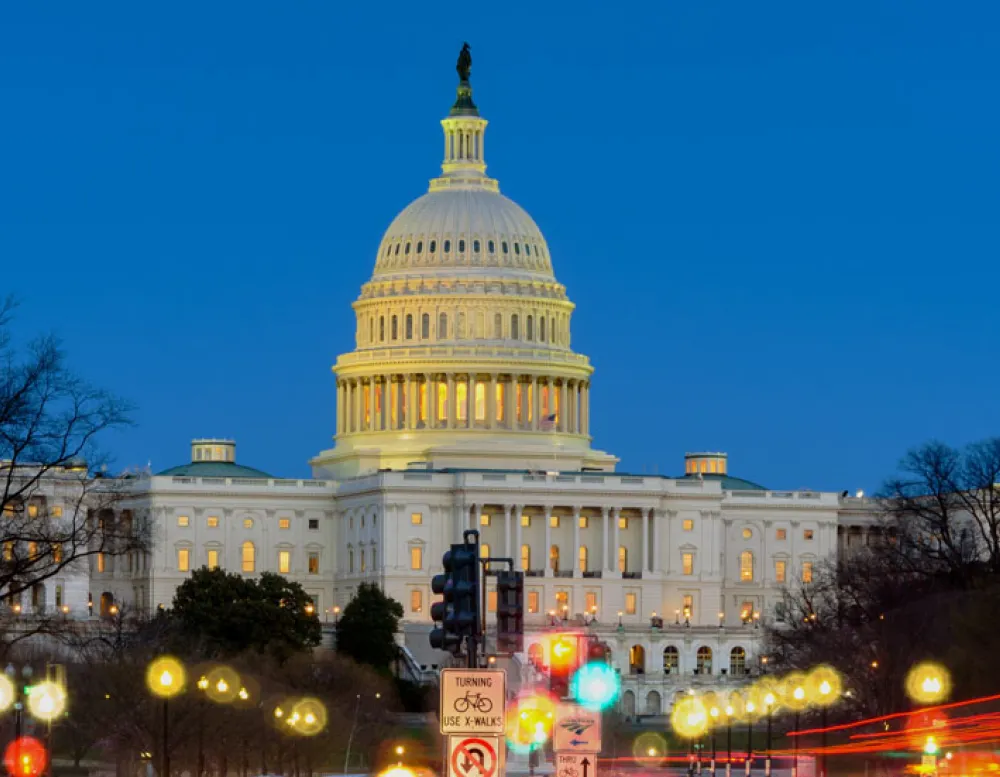
With an interdisciplinary foundation and a strong commitment to real-world application
this program prepares you to make an impact on local, national, and global issues.
Majors & Minors
| Program Name | Program Type |
|---|---|
Public Policy |
Major Bachelor of Arts |
Why study Public Policy?
You can major in public policy as a standalone major, or it pairs well with several other fields of study. A public policy dual major provides you with real-world perspectives and analytic skills that complement other majors.
Why study Public Policy at Gettysburg
Opportunities
Drawing on fields such as economics, political science, philosophy, and environmental studies, you’ll learn to evaluate problems from multiple angles and craft real solutions that make a difference.

Academics
With an interdisciplinary foundation and a strong commitment to real-world application, the Public Policy program prepares you to make an impact on local, national, and global issues.

Community of Experts and Professors
Our Public Policy Department faculty members empower students to become informed decision-makers, ethical leaders, and change agents in a rapidly evolving world.

The Public Policy major embodies Gettysburg College’s vision of an interdisciplinary liberal arts education. Students draw upon skills across disciplines to think critically and creatively, lead teams large and small, and communicate effectively and efficiently.
“The professors here have been really instrumental in helping me through my college life, whether it’s to apply for an internship or give me advice. They helped me focus on my interests and have directed me to graduate school.”
— Matthew Feldstein ’21
Public Policy in Action
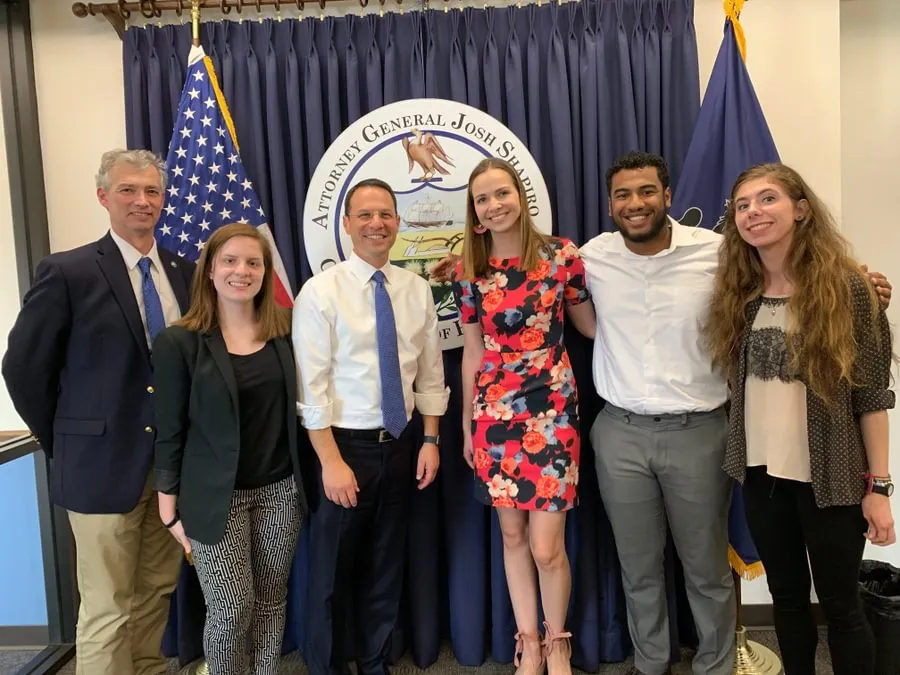
Students gain real-world policy experience in Pennsylvania state government
Christian Whitsel ’21 follows ‘policy passion’ to NYC hospital
Public Policy News

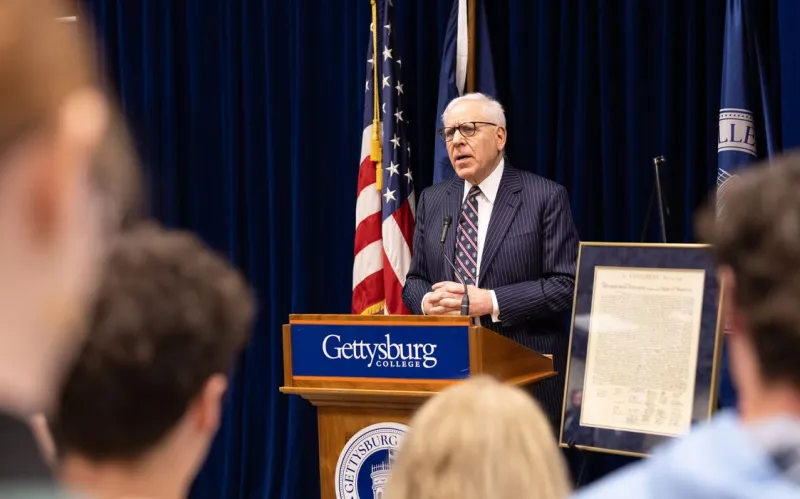


“Prof. Douds fiercely advocates for her students, and I could not have a better mentor.”
— Ella Prieto ’26
Center for Public Service
The Center for Public Service connects students and faculty with community-based work to foster social change. Learn about the ways for students and faculty to get involved, from volunteer opportunities to immersion projects, fellowships and grants.
Eisenhower Institute
The Eisenhower Institute prepares students to become leaders of change in the world of tomorrow through public policy programs that develop teamwork and problem-solving skills and unique experiential learning opportunities. Inspired by President Eisenhower’s approach of engaging diverse people and ideas to find common ground and take action. The nonpartisan Eisenhower Institute at Gettysburg College connects aspiring young leaders with public policy experts to discover their passion and tackle society’s most challenging issues.
Use the public policy major as a complement to another field of study. A public policy dual major can give you a rich understanding of policy with the eye of a specialist.
If you’re interested in:
- Science policy, you might dual major in Public Policy and Physics
- Health policy, you might dual major in Public Policy and Health Sciences or Biology
- Family policy, you might dual major in Public Policy and Sociology.
Major Information
Eleven courses and an internship are required for the PP major.
Four Foundational Courses
- PP 221 Introduction to Public Policy
- PP 251 Policy Research Design and Methodology
- One introductory government class: POL 101, 103, or 104.
- ECON 105 Economics of Public Issues or ECON 103
Two Advanced Courses
- PP 305 Advanced Public Policy Analysis
- PP 306 The Public and Its Problems or a Theory course approved by the Public Policy Chairperson
One Ethics and Values Course
- Choose one course from PP 227, 230, 237, 247, PP 301 Topic: The Worlds of Woodie Guthrie, PP 327, 362, PHIL 232, MGT 396, or a course approved by the Public Policy Ethics and Values Committee
One Societal-Level Policy Analysis Course
- Choose one course from PP 247, 250, 258, 265, 270, 304, 308, 314, 318, 323, 333, 341, 343, 346, ECON 104, 290 or POL 242.
Two Public Policy Elective courses
- Public Policy major electives may also be any course listed above that are not being used to satisfy a requirement, any courses offered in the Public Policy or Public Health Policy Departments or any of the following: PP201, 219, 222, 225, 262, 276, 299, 301, 312, 322, 344, 375, 377, ES 196, 309, MGT 303, POL/WGS 213, POL 399, 499, SYS 205, 206, 227, 229, 230.
- Choose two from the pre-approved courses listed above or seek approval of electives through your advisor
Internship and Capstone
- PP 470 Internship with Policy Concept Paper related to concentration
- PP 401 Capstone
Notes
- If a student has multiple majors, no more than two courses used to fulfill the requirements of a student’s other
First Year Advising and Registration recommendations
Public Policy students study how communities and societies define and respond to complex social problems. You can begin taking Public Policy courses right away, before declaring any major.
Common first-year courses
Take as soon as possible
- PP 221 Introduction to Public Policy (If PP 221 is full, join the waitlist. Spaces frequently open up.)
- ECON 105 Economics of Public Issues
- One of: POL 101 Intro to American Government, POL 103 Intro to International Relations, or POL 104 Intro to Comparative Politics
Available Courses
200 Level
Global overview of media industries in the world today. With a primary focus on cinema and TV, this course interrogates the political economy of the globalized media industries through economic, political, legal, and aesthetic analysis. Topics include the rise of multimedia, multinational conglomerates, followed by the impact of new technologies creating media convergence, and ending with sections on key global players in Europe and outside of the west. Course cross-listed as CIMS/IDS/PP 219.
This course explores how public policy can be used to address societal challenges and promote positive change, focusing on the intersection of policy, social issues, and community development. Students will engage in applied, community-based policy development and analysis in Gettysburg and the surrounding areas.
Study of the development of Mexico’s economic and social development in the Twentieth Century. The course focuses on two tasks: it provides an outline of economic and social development since independence and evaluates the process of industrialization in the twentieth century. The basic conceptual framework is that a socio-historical approach may help us understand the successive periods of growth and stagnation in Mexican society. What does the sociological analysis teach us about the current obstacles to social and economic development? SOC 276, LAS 276, and PP 276 are cross-listed.
Introduction to economic analysis of health care markets and health policy. In this course, we use economic analysis to understand individuals' demand for medical care and their role in health production, socioeconomic disparities in health outcomes, uncertainty and the role of insurance, adverse selection and moral hazard problems, the roles of physicians and hospitals as suppliers, pharmaceutical innovation and medical technologies, and the role of government programs in the US and internationally. Prerequisite: ECON 103 or ECON 105. ECON 270 and PP 270 are cross-listed.
Regulation of financial markets and institutions. The course examines risk-taking by financial market participants and attempts by government to regulate in the interests of financial stability. Special attention to the 2007 world financial crisis, the Dodd-Frank regulatory reform act of 2010, and current regulatory reform proposals. Taught from the perspectives of public policy, economics, and business management. Prerequisite: ECON 103, and 104 or ECON/BUS 267. Cross-listed as PP 265, ECON 265, and BUS 360.
A study of the development of Latin American states and societies. It first examines the various strategies employed by Latin American elites to develop capitalist societies that serve their interests. Mexico, Brazil, and Argentina are used to illustrate the implementation of these strategies. The second part of the course focuses on social movements to analyze the popular reaction to elites’ strategies of social development. It looks at social movements generally in the region, but it pays particular attention to Mexico, Brazil, and Argentina. SOC 262, LAS 262, and PP 262 are cross-listed.
Energy fundamentals and security issues. Course covers technological, economic and political aspects of energy production originating from oil, coal, conventional gas, shale gas, nuclear power, hydropower and other renewable sources. It examines how energy resources affect the national security and shape the domestic as well as global political economy. Topics include national oil companies, government control and regulation, OPEC dynamics, oil reserves, pipeline politics, LNG international trade, water-energy nexus, climate change, critical energy infrastructure, terrorism, energy diplomacy. Prerequisites: Economics 103 or 105 (or equivalent); or permission of instructor. ECON 258 and PP 258 are cross-listed.
This course is an introduction to the research process and is designed to make you both a better consumer and a better producer of research and knowledge. We will begin at its earliest stages and consider fundamental concepts, including how to conceive of – and write – good research questions and ask where data comes from. We will consider intermediate stages, including what available evidence
exists that might answer our question or consider why this question has not been asked yet. We will end our journey by learning about specific tools or methods you can use to answer specific questions and understand when which tool is best. Prerequisite: PP 221 PP 251 and PHP 251 are cross-listed.
Overview of the criminal justice system in the U.S. and the role of police, attorneys, judges, trials, and prisons. Primary goal is for students to gain an understanding of how the criminal justice system works in the U.S., both from a criminal justice studies and legal perspective. Major U.S. Supreme Court cases are read to illustrate the nature of legal reasoning and criminal justice problems, with each student having his or her own case to work on throughout the term. LAW 250 and PP 250 are cross-listed.
What is health, and how have science and medicine, as social institutions, helped us to frame health in terms of places, people & politics? In what ways do our communities—from family to nation-state—help or hinder our life course and affect our access to medicine and medical technologies? How has science reproduced frameworks of discrimination via colonialism, racism, sexism, and ableism? Can we, as global citizens, cultivate a ‘One Health’ approach to these challenges? Taking a richly multi-disciplinary lens by drawing on the lessons of history, sociology, anthropology, and cultural studies, this class attempts to answer such questions through a biopolitical and necropolitical theoretical framework. Our readings and research will focus on the intertwined histories and contemporary realities of colonialism and medicine; pandemics and prophylaxis; politics and public health; gender, ableism and the body; medical technologies and artificial intelligence; and the medicalization of disease and death. This class will be largely discussion-based, with student presentations and an essay-based midterm and final. This course will count as an elective in the Sociology, Public Policy, and Public Health Policy majors and the Sociology and Peace & Justice Studies minors. Prerequisites: SOC 101, 102 or 103; or HS 120; or permission of the instructor. SOC 239 and PP 239 are cross-listed.
What is right and wrong? How to become a better person? Is it even possible to be or do good? With so many different and competing ideas in the world, how do we know which ideas to believe? Consider these and other fundamental questions in ethics across a range of theories and systems, including consequentialist, duty-, and virtue-based models, environmental ethics, and human rights, among others. Engage with a global range of philosophical texts and authors, through a diverse range of course material and assignments, including film, poetry, journalism, and speeches, as well as philosophical essays. PHIL 230 and PP 230 are cross-listed.
Critical examination of the relationship between ethics, religion, and society. Offers critical approach to the association of religion with the development of values, ethics, and social responsibility. Course relies upon theories offered by key thinkers in the study of religion and ethics to reveal religious phenomena in the contemporary world as having tremendous impact upon social structures. REL 227 and PP 227 are cross-listed.
This foundational required course for the Public Health Policy major examines how public health policy operates in complex webs of governmental, non-governmental, non-profit, and private organizations that deal with wicked public health problems. This course introduces students to all major types of public health organizations’ missions and operations at local, state, national, regional, and global levels. Simultaneously, the course requires students to analyze health outcome optimization from an organizational perspective and communicate with the public on public health issues. Prerequisite: PHP 221 or PP 221. PHP 222 and PP 222 are cross-listed.
This foundational course for the Public Policy and Public Health Policy majors covers all major areas of public policy studies and provides in-depth analysis of policy making processes and outcome evaluation. The class begins with problem definition, examining how communities and societies define, prioritize, and respond to complex, “wicked” social problems. The course examines the policy process, historical antecedents to the discipline, foundational policy theory, and several models for analyzing policy. The course then proceeds through a series of policy arenas, allowing for topic-specific consideration of key aspects of policy analysis. This course lays the foundation for all subsequent study of public policy and public health policy, and it is a prerequisite to all upper-level Public Policy classes and the required internship. PHP 221 and PP 221 are cross-listed.
300 Level
Charters. Choice. Testing. Standards. Equity. Over the past three decades public opinion has coalesced around the idea that our public schools are failing and desperately in need of reform. How much truth is there in these assertions? This course explores the implications of public school reform policy choices, focusing especially on the way reformers have framed the debate to their advantage. Special attention is paid to teacher quality, urban education, school choice, testing, and other issues raised by reform advocates. EDUC 377 and PP 377 are cross-listed.
What do the world’s religions say about violence and non-violence? This course examines how varying religions define, understand, participate in, promote, or condemn violence. When is violence justified, according to different religions, and when is it not? When and how is religion a force for peace? Do some religions actively promote violence? Do others actively promote non-violence? Do some do both? This seminar explores these and other questions by examining the theologies. histories, scriptures, practices, philosophies, and symbols from world religions regarding violence and peace. Students will also learn theories and explanatory models applied by scholars of religion to answer the questions above. Particular emphasis is given to thinkers and activists in the Middle East and North Africa, South Asia, and North America. REL 362 and PP 362 are cross-listed.
Interactive course combining study of fundamental texts with student-led research projects. Students learn how public policy problems are defined and policy responses are developed, evaluated, and implemented. Students work intensively with the professor to apply these principles to an issue that interests them. The final output is a comprehensive white paper on the issue and recommended policy response. Prerequisite: PP 221 PHP 305 and PP 305 are cross-listed.
This course examines the foundations of national security law that empower (and restrain) the exercise of criminal enforcement, military, and intelligence authorities against threats to the U.S. Through readings, discussion, and visiting experts, we study constitutional and statutory law, covert action, detention, interrogation, targeted killings, military commissions, encryption, surveillance, artificial intelligence, and the Article II authorities of a president, that animate ongoing, difficult, and vital public policy debates. Prerequisites: POL 103 or PP 221.
This course explores the key aspects of energy supply and demand covering issues in electricity, natural gas and oil sectors of the economy. It discusses the role of markets, regulation and deregulation of the industry. The course addresses market design questions related to energy generation, transmission and distribution. It also provides an overview of economic institutions designed to control pollution emissions and examines other public policies affecting energy markets. Prerequisites:Econ 241 and 245. ECON 344 and PP 343 are cross-listed.
Investigation of the relationship between the economy and the environment, conditions for a mainstream theories and policies, including those based on externalities and social costs, property rights, cost-benefit analysis, and discounting, are studied in the light of conditions required for sustainability. Problems and prospects of both market controls and government regulation are considered. Special topics include renewable resources, valuation techniques, accounting for pollution and resource depletion in GDP statistics, and sustainable development. Prerequisite: Econ 245. ECON 341 and PP 341 are cross-listed.
Analysis of the policies that guide the use, control and management of natural resources. Students examine the laws, bureaucracies, economics, politics and ideologies underlying policy making processes in order to understand how and why certain policies emerge as well as their social and ecological effects. The primary focus is on the United States, but the growing international dimension of environmental policies and the ambiguous role of the US in these efforts is also considered. Prerequisite: ES 196 or POL 101. ES 333, POL 333, and PP 333 are cross-listed.
Critical examination of the relationship between ethics, religion, and society. Offers critical approach to the association of religion with the development of values, ethics, and social responsibility. Course relies upon theories offered by key thinkers in the study of religion and ethics to reveal religious phenomena in the contemporary world as having tremendous impact upon social structures. REL 327 and PP 327 are cross-listed.
This course analyzes the social determinants of health – the non-medical and non-health factors that affect health outcomes. Social factors, such as education, race/ethnicity, income, environment, and housing, shape our health in obvious – and not-so-obvious – ways. This course outlines the historical causes of various social factors, illustrates how these social factors harm health, including the particular health outcomes linked with each of them, and examines public policies
designed to mitigate the deleterious effects of these social factors. HS 323, PHP 323, and PP 323 are cross-listed.
Interdisciplinary public policy seminar offered on a specific topic each year. Seminar encompasses an examination of the decision-making process from the original articulation of needs through official responses and on to measuring the impacts of those decisions in the public domain. A prominent authority in the field of public affairs is invited to direct the seminar each year, with the focus of each course being determined by that person's field of endeavor and expertise.
Explores the economic-theoretical developments that have taken place in the Western world since the Great Depression, as well as the ethical and philosophical considerations that those developments entail. The three central tenets of neoliberal ideology are: (1) Deregulation; (2) Privatization; and (3) Free Trade. But as a holistic vision of the world, neoliberalism entails the commodification of every facet of our lives. Issues to be discussed in the course include: the relation between the state and the individual, the connections between social and economic conservatism, the responses (or lack thereof) to the AIDS crisis in the 1980s, globalization and its impacts, immigration and racism, “fake news”, and the extent to which economic encroachment may impede the egalitarian aims of democracy.
IDS 308 and PP 308 are cross-listed.
Policy design and implementation are obviously of central importance in the policymaking process, but where do ideas for policy solutions come from? This course explores how societies define public policy problems, how and why they choose to respond to those problems, and how they approach policy reform. Special emphasis is placed on the political, historical, and philosophical foundations of policymaking projects and how the pursuit of a better society frames the policymaking process. Prerequisite: PP 221; or permission of the instructor
Explores some of the major works of 20th century French thinker and cultural critic, Michel Foucault. Few thinkers of the 20th century had a greater or more lasting impact than Foucault. Giving a new meaning to the adage, ‘knowledge is power,’ Foucault’s work challenges accepted orthodoxies regarding the concept of ‘truth’ by examining fundamental questions of power and knowledge, demonstrating the ways in which they are intertwined, as well as how that ‘knowledge’ shapes our understanding of ourselves. Fueled by the turmoil of the 1960s, Foucault’s writing crosses traditional disciplinary boundaries, leaving an indelible mark in areas as diverse as philosophy of education, history, literary theory, sociology, aesthetics, health studies, epistemology, gender and sexuality studies, and prison reform.
IDS 305 and PP 304 are cross-listed.
This course is designed to serve as a bridge between the introductory Public Policy course (POL 221) and the senior capstone course in Public Policy (PP 401). Topics covered include an analysis of individual and collective behavior relevant to policymaking, an exploration of the role of markets and government in responding to public policy problems, and an in-depth survey of tools and techniques for public policy analysis (such as cost-benefit analysis and program evaluation).
400 Level
Topics differ each year. Students read a common core of literature in the field of Public Policy as well as specific readings on the seminar topic. Students also produce a major research project. Prerequisite: PP 221 or PHP 221. PP 401 and PHP 401 are cross-listed.
Individualized tutorial not counting in the minimum requirements in a major or minor, graded A-F
Internship counting toward the minimum requirements in a major or minor, graded A-F
Internship counting toward the minimum requirements in a major or minor, graded S/U
Public Policy

More In Public Policy
Ready to Do Great Work?
